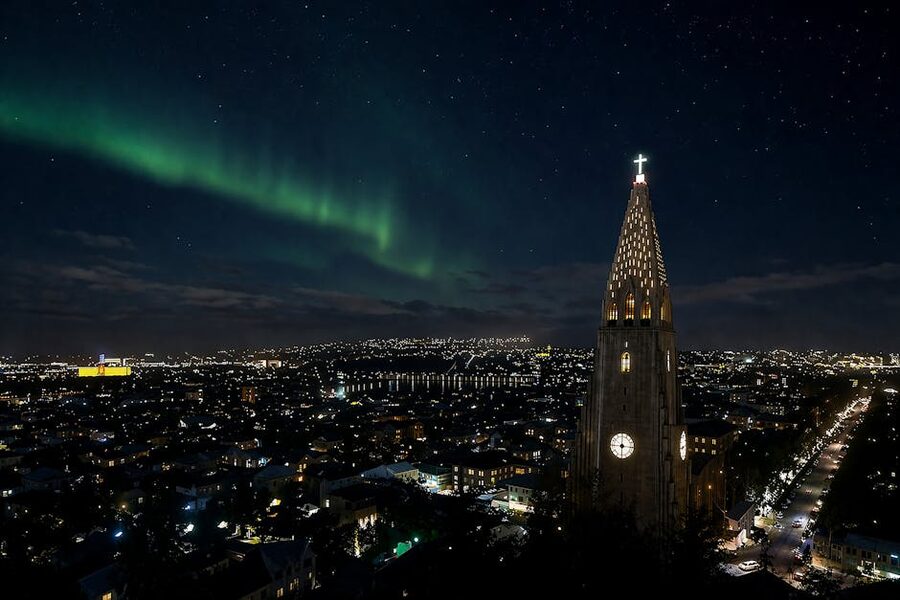
December in Iceland looks different to what most people expect. The sun rises around 11:30 and calls it a day by 3:30. A storm might close Route 1 in the afternoon and clear it again by breakfast. And somewhere in a farmhouse in the north, a ten-year-old is putting a shoe on the windowsill because Gluggagægir, the Window Peeper, is coming tonight.
That’s the one people forget to mention. Iceland doesn’t have one Santa. We have thirteen Yule Lads, a cat that inspects children’s new clothes, and a national book flood on the 24th. If you’re thinking about visiting Iceland in December, or just curious about what actually happens up here, this is how Christmas really works.
In This Article
- 1. The December dark is real, and shorter than you think
- 2. Christmas runs 26 days, not one
- 3. Thirteen Yule Lads, not one Santa
- 4. Grýla, Leppalúði, and the cat that eats children
- 5. Six o’clock on the twenty-fourth stops the country
- 6. What’s on the Christmas Eve table
- 7. The twenty-third of December is a kitchen day
- 8. Þorláksmessa, fermented skate, a smell you’ll remember
- 9. Jólabókaflóð, the Christmas book flood
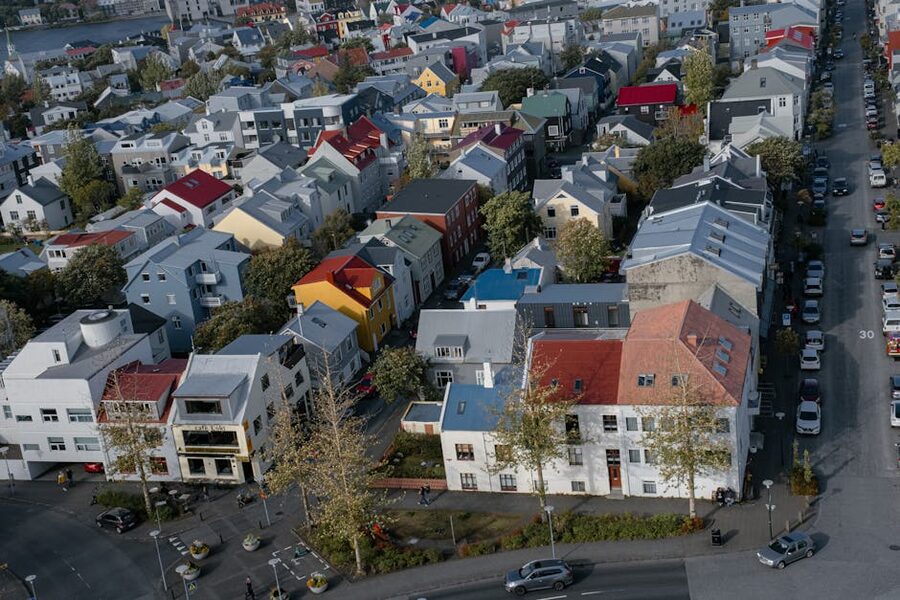
- 10. Reykjavik at Christmas
- 11. Christmas Day and the days after
- 12. New Year’s Eve is a national bonfire
- 13. Þrettándinn, when the elves come out one more time
- A few practical notes if you’re coming
1. The December dark is real, and shorter than you think
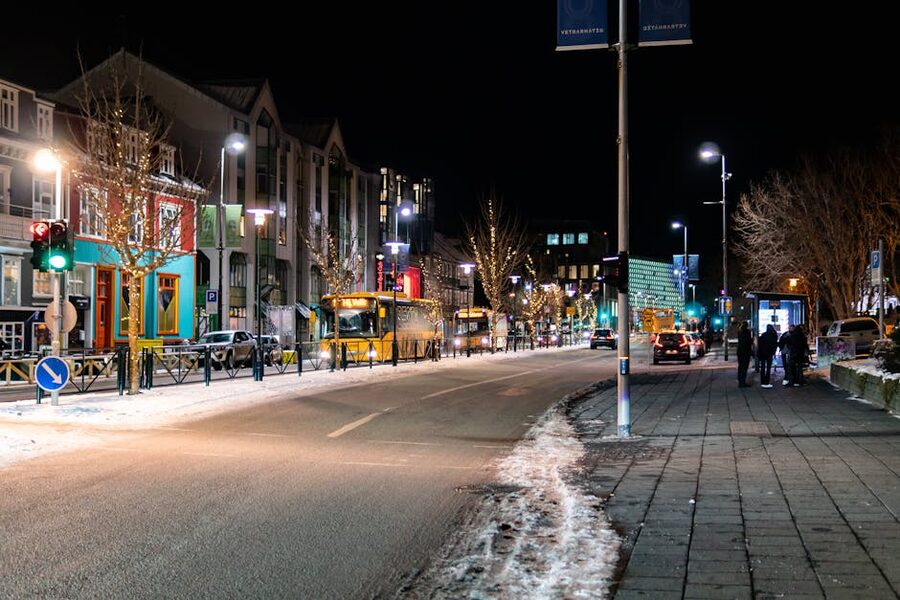
Here’s the honest version: Iceland’s December isn’t as dark as you imagine. It’s darker. Reykjavik sees sunrise around 11:30 and sunset just after 3:30, which gives you roughly four hours of daylight, and even then, the sun barely clears the rooftops. Mid-morning looks like dusk. Mid-afternoon looks like nine o’clock on an overcast autumn day.
So the whole country runs on coffee and Christmas lights. Every shop window has a candle in it, every street lamp goes on by 2:30, and by the middle of the month you stop fighting the dark and start to enjoy it. The aurora, norðurljós, is out most clear nights once the solar activity picks up. I’d check vedur.is around lunchtime before planning anything north of Reykjavik for the evening.
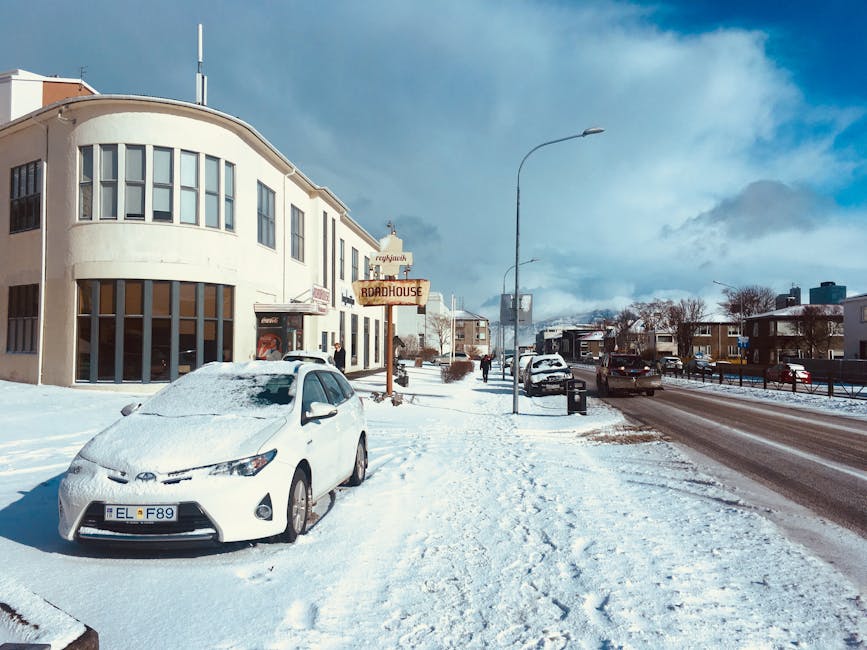
The weather honestly: storms can close Route 1 for 24 hours, wind routinely passes 20 m/s, and gusts over 30 are normal on the south coast. Don’t plan tight itineraries between the 20th and the 28th. Þetta reddast, it’ll work out, but only if you leave yourself slack.
If you’re coming from somewhere warmer, don’t underestimate layering. A Reykjavik local in December wears wool leggings, wool socks, waterproof boots, a merino base, a mid layer, a wool jumper, and a windproof outer shell. The outfit you’d bring for a ski trip won’t keep you warm in horizontal sleet at Seljalandsfoss.
The flip side of the dark is the stillness. A walk around Tjörnin, the pond in the centre of town, at four in the afternoon, when the city lights come on and the geese stomp around on the ice and nobody else is out, is one of the better reasons to come here in winter at all.
2. Christmas runs 26 days, not one
Most countries light a tree, open presents, eat dinner, and call it done. We stretch the whole thing to twenty-six days.
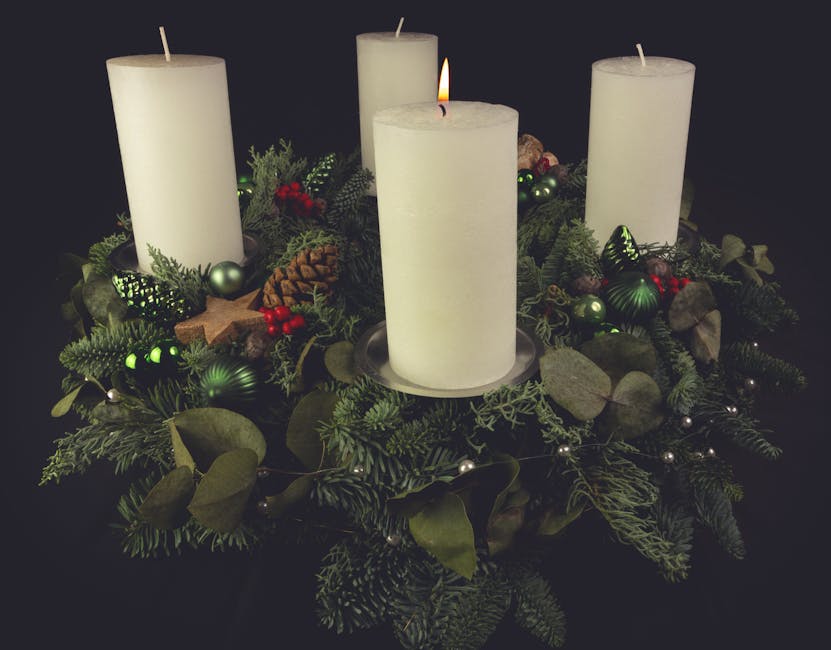
It starts on the 11th of December, when the first Yule Lad comes down from the mountains. Or, if you’re going by the religious calendar, four Sundays before the 24th, when the first advent candle gets lit. Either way, the first half of December is the run-up. Most Icelandic homes put the tree up around the same time the first Yule Lad arrives, and children begin leaving a shoe in the window at night.
Christmas proper begins at 6 p.m. on the 24th, Aðfangadagur, “the day before”, not at midnight and not on Christmas morning. It runs through Jóladagur (the 25th), Annar í jólum (Boxing Day), the quieter days to the 30th, Gamlárskvöld (New Year’s Eve), Nýársdagur (New Year’s Day), and finally Þrettándinn, “the Thirteenth”, on the 6th of January. That’s the day the elves and the last Yule Lad head back into the mountains, the bonfires are lit for the last time, and the tree comes down.
So when someone asks “when is Christmas in Iceland,” the right answer is “which part.” If you’re visiting any time between the 11th of December and the 6th of January, you’re in Christmas whether you meant to be or not.
Practical note for visitors: shops, buses, and most museums run normally through the 23rd, close hard from the afternoon of the 24th through the 26th, stay quiet the 27th–30th, then come alive for New Year’s. You can’t eat in most Reykjavik restaurants on Christmas Eve or Christmas Day, a few hotel restaurants stay open, and you need to book those ahead.
3. Thirteen Yule Lads, not one Santa
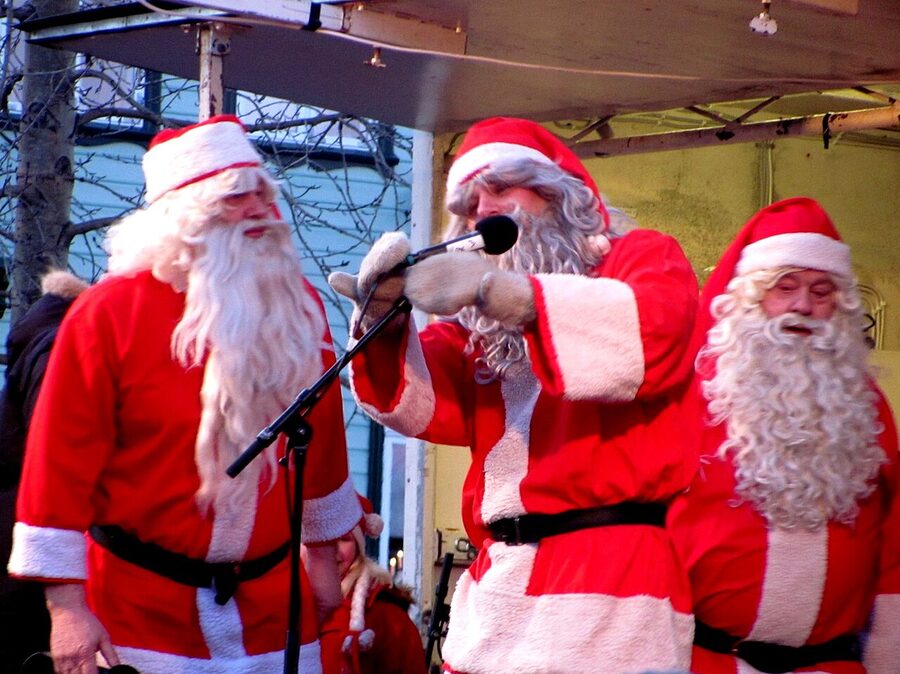
This is the one I get asked about most. No, we don’t have a Santa. We have thirteen Yule Lads, jólasveinar, who are the sons of two mountain trolls, Grýla and Leppalúði. They’re not jolly. Or they weren’t, historically. In the old days they were proper feral beings, the sort parents invoked to keep children honest. Over the last hundred years they’ve mellowed into something closer to Santa, but each Yule Lad still has his own specific prank he’s known for.
They come one per night, starting on the 12th of December and ending on the 24th. Children leave a shoe in the window the night before each arrival. If the child’s been good, they find a small gift, a mandarin, a chocolate, a toy. If they’ve been bad: a potato.
The order, and what each one is known for:
- 12 Dec, Stekkjarstaur (Sheep-Cote Clod): tries to drink the ewes’ milk on stiff peg-legs. Never quite manages it.
- 13 Dec, Giljagaur (Gully Gawk): hides in roadside gullies and steals the foam off cow’s milk.
- 14 Dec, Stúfur (Stubby): the short one, scuttles after the burnt crust scraped from frying pans.
- 15 Dec, Þvörusleikir (Spoon Licker): steals wooden stirring spoons and licks them clean.
- 16 Dec, Pottaskefill (Pot Scraper): goes after the leftovers in cooking pots.
- 17 Dec, Askasleikir (Bowl Licker): hides under beds waiting to snatch your askur (wooden bowl).
- 18 Dec, Hurðaskellir (Door Slammer): slams every door in the house at three in the morning.
- 19 Dec, Skyrgámur (Skyr Gobbler): goes straight for the skyr.
- 20 Dec, Bjúgnakrækir (Sausage Swiper): hangs in the rafters and snatches smoked sausages as they cure.
- 21 Dec, Gluggagægir (Window Peeper): peers through the windows looking for things worth coming back for.
- 22 Dec, Gáttaþefur (Doorway Sniffer): has an enormous nose and sniffs out the laufabrauð in the kitchens.
- 23 Dec, Ketkrókur (Meat Hook): uses a long hook through the chimney to steal smoked lamb.
- 24 Dec, Kertasníkir (Candle Stealer): follows children around trying to eat their tallow candles, which used to be made of animal fat and were genuinely edible.
After the 24th they leave one per day in reverse-arrival order. The first to arrive, Stekkjarstaur, leaves on Christmas Day; the last, Kertasníkir, heads back to the mountains on the 6th of January.
If you want to meet them in person, the National Museum (Þjóðminjasafnið) runs a Yule Lad schedule through December, and there are usually Yule Lad visits at the Árbær Open Air Museum. The full-size statues in Akureyri, the one city in the north worth a winter weekend, are a good photo op.
4. Grýla, Leppalúði, and the cat that eats children
Their mother is the part visitors find genuinely unsettling.
Grýla is an old troll who lives in a cave in the mountains, usually said to be somewhere east of Dimmuborgir near Mývatn, though every region has its preferred location. She eats children. Specifically, the naughty ones. She’s usually depicted with a cauldron on her back, and she’s been in Icelandic poetry since at least the thirteenth century, which means she was scaring children around the time of the Black Death.
Her husband, Leppalúði, is a lesser figure. Lazy, mostly sleeps. He fathered the thirteen Yule Lads with her after her previous two husbands died under circumstances she never quite explains.
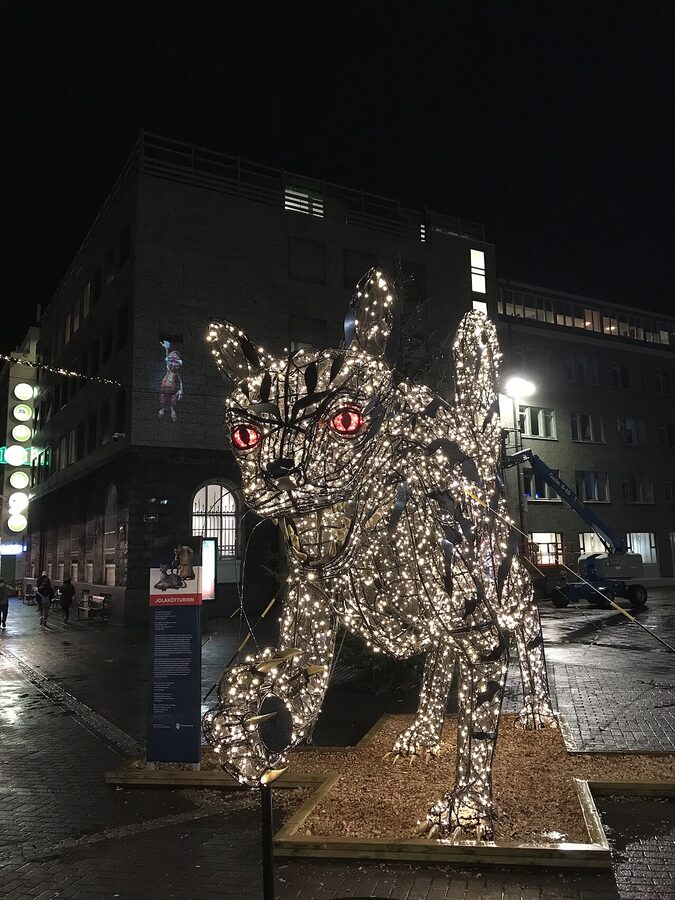
And then there’s Jólakötturinn, the Yule Cat. The cat is enormous. It prowls the country at Christmas and eats any child who doesn’t get new clothes for Christmas. This sounds like a joke until you realise it was a genuine social pressure tool: new clothes meant your household had finished its autumn work, the wool had been processed, the sweaters knitted, and the cat’s threat was essentially “finish your chores or be eaten.” A gift of socks at Christmas in Iceland is not a dull present. It’s a way to keep you safe from a specific monster.
These days, there’s a twelve-metre-tall steel Yule Cat sculpture on Lækjartorg in central Reykjavik through December, strung with lights. It’s one of the most photographed objects in the country for three weeks, and children line up to take selfies standing inside its legs.
5. Six o’clock on the twenty-fourth stops the country
There’s a moment at 6 p.m. on Christmas Eve when the entire country stops.
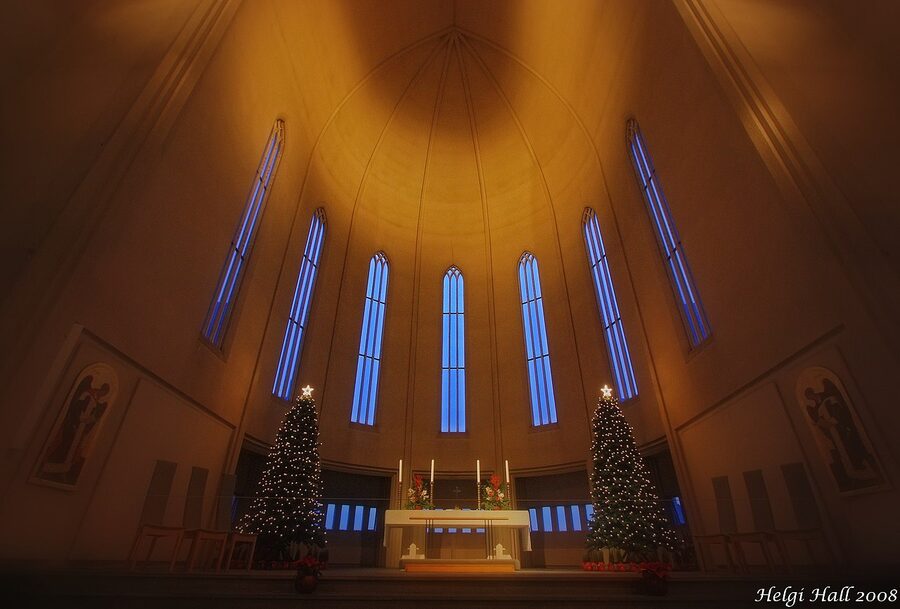
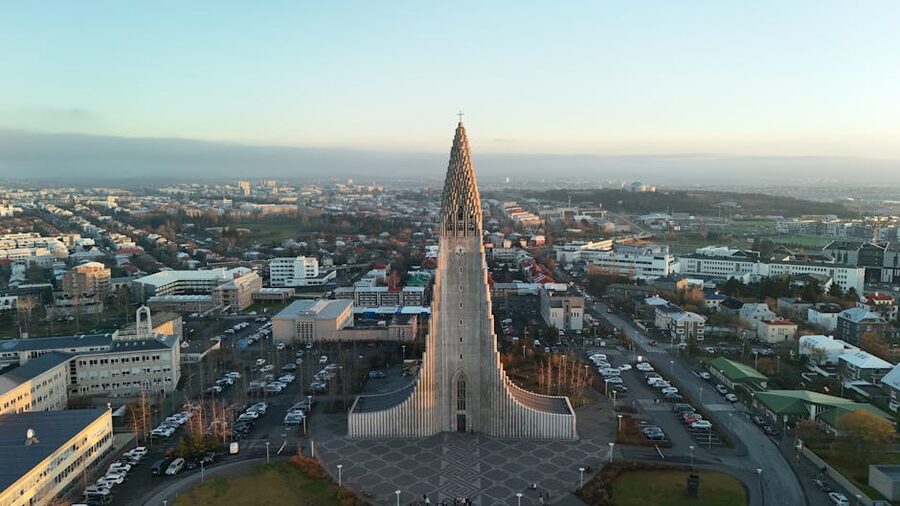
Church bells ring. If you’re in Reykjavik, you’ll hear Hallgrímskirkja over every other church because it’s on the hill. The bells are broadcast live on RÚV, the national radio, and simultaneously the Christmas mass begins. The religiously observant head to church now; the rest stay home. Either way, dinner starts the moment the bells have finished.
This is not a casual family dinner. It’s the big one. Everyone is in their new clothes, jólaföt, Christmas clothes, for the exact reason mentioned above. The table is laid properly, the candles are all out, and there’s a pile of presents under the tree that nobody has touched. The radio plays classical music or hymns quietly in the background. Phones go off. Kids who’ve been told since October that they cannot open their presents until dinner is finished finally get their payoff.
After the meal, which takes an hour or so, you open the presents. Traditionally one at a time, slowly, everyone watching, so it takes another two or three hours. The eldest in the family passes them out. There’s no rush. Outside it’s dark and usually snowing. Inside there’s hot chocolate, ice cream cake for dessert, jólaís, often orange-and-chocolate, and a new book to read when everyone else has gone to bed.
If you’re in Reykjavik on Christmas Eve, the 6 p.m. service at Hallgrímskirkja is worth attending even if you’re not religious. It’s free, it’s sung in Icelandic, the acoustics of that concrete nave are hard to beat, and you’ll walk out into the quietest city you’ll ever see.
6. What’s on the Christmas Eve table
The plate changes by household, but the core is remarkably consistent.
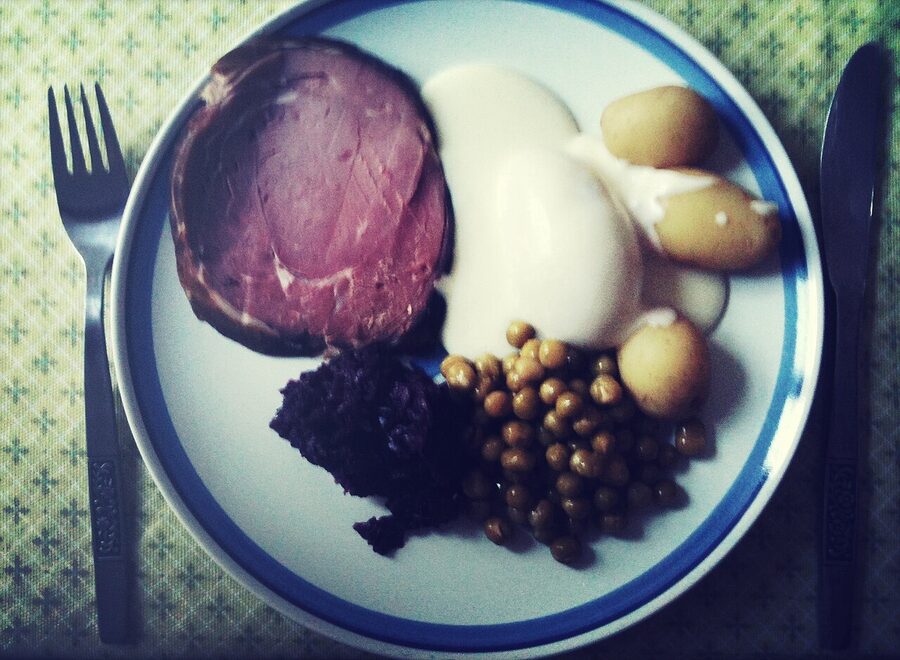
Hangikjöt, smoked lamb, is the centrepiece for many families. It’s lamb shoulder or leg cured in brine, then smoked slowly over birch wood or, in the traditional way, sheep dung. Yes, really, and the taste is distinct. It’s served cold or warm, sliced thin. Alongside it: a béchamel-style white sauce with peas and sometimes carrots (uppstúf), green peas, red cabbage, and potatoes. Often the potatoes are glazed with caramelised sugar and butter, brúnaðar kartöflur, “browned potatoes”, which taste nothing like you’d expect.
Rjúpa, ptarmigan, is the other classic. A small arctic game bird hunted in October, frozen, and brought out for Christmas. It’s richer than pheasant, closer to duck, served with a game sauce, redcurrant jelly, and the same caramel potatoes. Rjúpa is getting expensive, the Environment Agency limits the hunt to a few weekends each autumn, and some families have quietly moved on to pork or turkey. The traditionalists won’t budge.
Hamborgarhryggur, glazed smoked pork loin, has crept in over the last few decades and is now almost as common as hangikjöt. It’s smoked, glazed with pineapple or a brown-sugar-and-mustard crust, and easier to cook for a crowd.
For starters: often graflax (gravad salmon), or a prawn cocktail, or a mild soup. For dessert: ris à l’amande (a Danish-inspired rice pudding with a hidden almond, whoever finds it wins a prize), or ice cream cake, or pavlova. Drinks: Malt og appelsín, a mix of non-alcoholic malt beer and orange soda that tastes strange to visitors and is treated as sacred by everyone else. Or jólaöl, the Christmas ale that gets a fresh recipe from a brewery each December.
The food isn't fancy. It's what your grandmother cooked, done well, and eaten slowly. That's the whole point. For the rest-of-the-year picture, what Icelanders actually eat on Tuesdays, where to eat it in Reykjavik, and what to skip, I covered everything in what to eat in Iceland from a Reykjavik local.
7. The twenty-third of December is a kitchen day
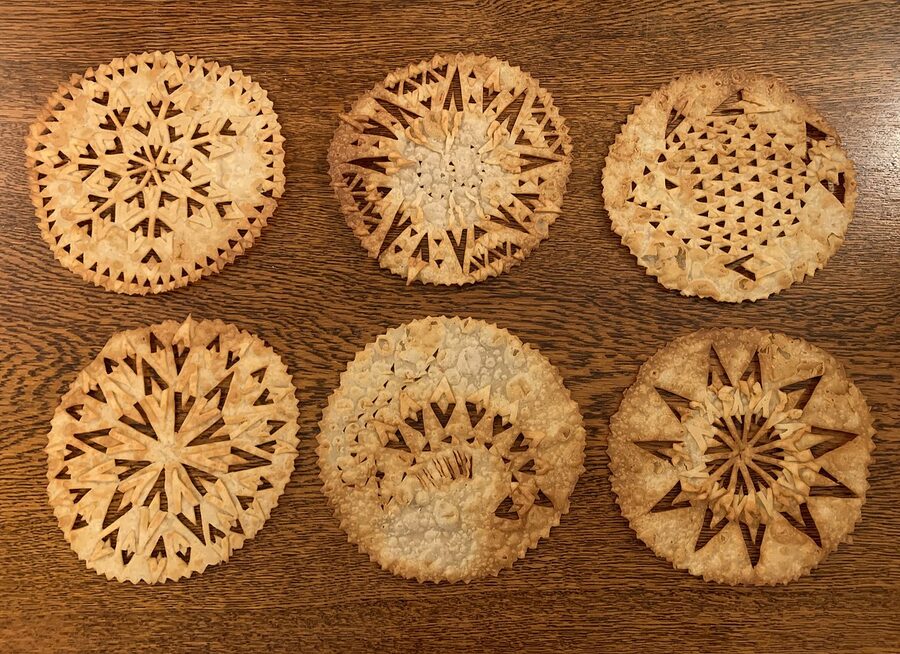
Laufabrauð, leaf bread, is one of the reasons people come home for Christmas in the first place.
It’s a flat, paper-thin disc of rye-and-wheat dough, roughly the size of a side plate, decorated with intricate geometric cut-outs. After decorating it’s deep-fried for a few seconds, the dough puffs slightly, the patterns darken, and you end up with something that eats like a very thin savoury cracker and looks like a snowflake.
The point of laufabrauð isn’t the eating, though. It’s the making. Most families do it together on the 23rd of December. The kitchen gets commandeered, the dough is rolled out in long sheets, and every adult who’s come home for Christmas takes a turn decorating their disc. Some families use a special tool, a laufabrauðsjárn, a small wheel-and-blade, and some just use a knife. The better artists in the family do elaborate patterns with layered folds; the rest of us do our best.
It’s social. There’s coffee, there’s someone’s grandmother explaining the pattern she learned from her grandmother, and there’s judgement when the frying doesn’t go right. A disc that tears is a disc that tears, you eat it anyway.
The tradition comes from the north, from Akureyri and Eyjafjörður, where wheat was scarce and the thin dough was a way of making a little flour go a long way. For a century it was the only white bread some households had all year, which is why it ended up on the Christmas table. These days you can buy laufabrauð ready-made at Krónan or Bónus, but almost nobody does. It’s the one thing worth setting a day aside for.
If you want to try making it, Salt Eldhús and the Kitchen Academy both run laufabrauð workshops in English in mid-December, you’ll find them on their websites each year around the 1st.
8. Þorláksmessa, fermented skate, a smell you’ll remember
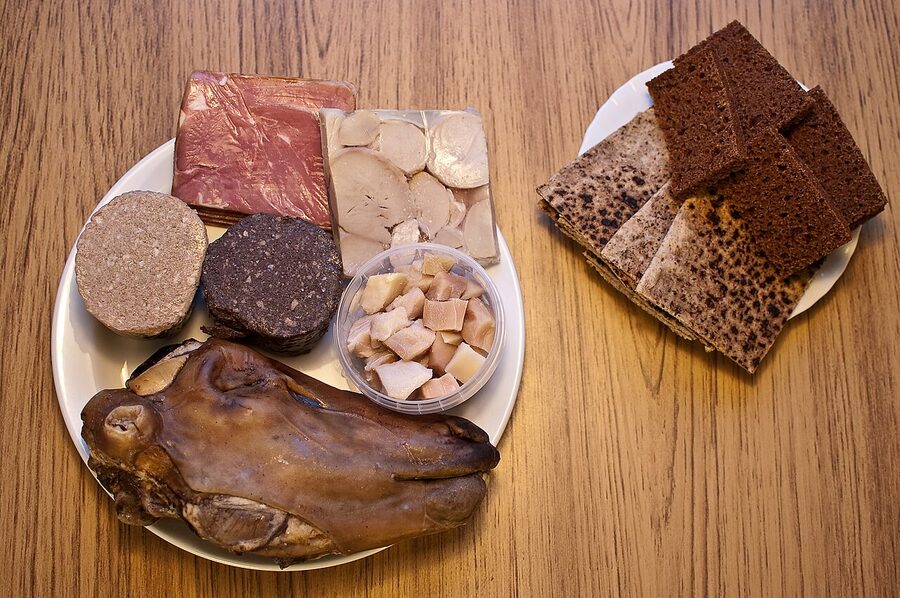
The 23rd of December is also Þorláksmessa, Saint Þorlákur’s Mass. And it’s the day for fermented skate.
Kæst skata is exactly what it sounds like: skate that’s been buried, fermented in its own ammonia, and aged until a veteran chef would pause. You eat it boiled, served with melted sheep’s tallow (hamsatólg), potatoes, rúgbrauð (dense rye), and a glass of Brennivín, caraway schnapps, to take the edge off afterwards. The Brennivín is not for show. The skate smells like ammonia. Eaten committed, it tastes like ammonia. The older the skate, the more intense the whole experience.
It’s an acquired taste. Some Icelanders wait all year for it; others have never touched it and never will. If you’re visiting, Þorláksmessa is the day to find a family restaurant that serves it, Þrír Frakkar and Kaffi Loki both do a proper skate lunch, and the smell will meet you at the door. You don’t book. You turn up around noon and queue.
Saint Þorlákur was a twelfth-century bishop of Skálholt, canonised in 1983 by John Paul II, the only Icelander with an official saint’s day. The connection to skate is older than the canonisation: the custom probably dates to a time when skate was one of the few fish you could actually get in late December, when the weather was too rough to go out. You ate what had been preserved, and the preservation method of choice was fermentation, because everything else froze solid.
If the skate isn’t for you, and it’s not for everyone, most of the same restaurants serve plain baked cod or arctic char alongside it. But the smell will get into your clothes, and you will remember the meal.
9. Jólabókaflóð, the Christmas book flood
This is my favourite. Iceland publishes more books per capita than any other country, and the annual Christmas book flood, Jólabókaflóð, is the reason why.
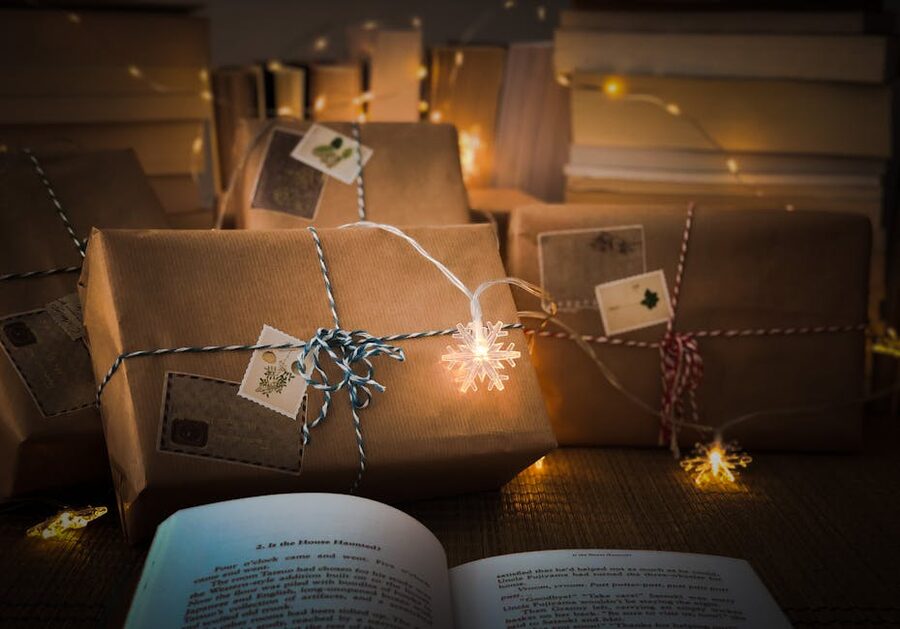
Here’s how it works. Every autumn, the Association of Icelandic Publishers sends a catalogue called Bókatíðindi to every household in the country, free, by post, sixty-odd pages of every new book being published that year. You leaf through it the way other countries’ households leaf through an IKEA catalogue. By mid-November, families are marking which books are for whom. By early December, the books are wrapped and under the tree.
On Christmas Eve, after dinner, after the presents, everyone heads to their own corner of the sofa with the book they just unwrapped and a cup of hot chocolate. That’s the whole evening. A country that averages roughly one book gifted per person at Christmas then spends the rest of that night reading it.
If you want to take part as a visitor, and you should, the easiest way is to stop at Forlagið, Penninn Eymundsson, or Mál og Menning. Any of their Reykjavik branches will have a Christmas table up through December. You don’t need to read Icelandic for it to work: many of our authors have been translated well (Yrsa Sigurðardóttir, Arnaldur Indriðason, Sjón, Auður Ava Ólafsdóttir), and the shops stock the English editions alongside. Paperbacks run around 3,500–6,500 ISK.
What you don’t do, culturally, is give someone chocolate without a book. You can give them a book without chocolate. Not the other way around.
Bókatíðindi itself is worth taking home. You can pick up a free copy at any bookshop in December. It’s the best single souvenir of the season.
10. Reykjavik at Christmas
The capital transforms in early December.
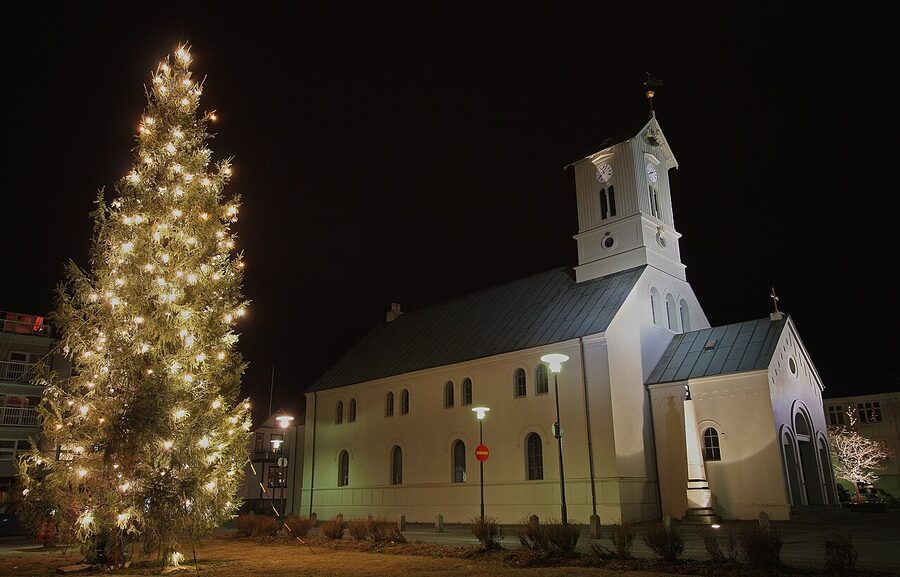
The big one is the Oslo Christmas tree on Austurvöllur, the square in front of Alþingi, the parliament. Since 1951, the city of Oslo has shipped a large Norway spruce to Reykjavik, and the tree goes up and lights up on the first Sunday of Advent. The lighting ceremony has speeches and a choir and hot chocolate handed out in paper cups, and it’s a proper community event rather than a tourist show. Tourists are welcome, obviously, you just won’t be the only ones there.
The Yule Town market at Ingólfstorg runs weekends in December: mulled wine (jólaglögg), sheepskin mittens, knitted hats, woodwork, candles, horse sausage on a stick. The scale is small, maybe twenty stalls, which is part of why it works. You’re not in a German Christmas village. You’re in downtown Reykjavik with lights strung between the buildings.
About a fifteen-minute drive south, out in the Heiðmörk forest reserve, there’s an annual forest Christmas tree sale run by the Scout Association. You can saw down your own tree, drink hot cocoa from a paper cup, and come back with a tree and a bag of branches for making a wreath. Get there before 2 p.m. or you’ll be sawing in the dark.
Laugardalur, the valley where the big geothermal pool is, becomes a small Christmas valley with lights and an outdoor ice rink that kids love. Free to walk; Laugardalslaug pool entry is around 1,340 ISK for adults and is my pick if you want a properly local experience.
Harpa, the concert hall down on the harbour, runs a full Christmas programme. The Iceland Symphony Orchestra’s annual Christmas concert, usually in the second week, is the classical choice; Sinfó á jólum, candles and carols, is the gentler one. Tickets run about 8,000–12,000 ISK.
If you want to skate, there’s a small open-air rink on Ingólfstorg through December, skate hire around 1,200 ISK.
For a proper Christmas feast at a restaurant, most places close on the 24th–25th, but many do a pre-Christmas jólahlaðborð buffet through early-to-mid December. Grillmarkaðurinn does the high-end version; Hótel Holt does the old-school one. Book a fortnight ahead.
11. Christmas Day and the days after
Jóladagur, Christmas Day, is family day. You visit your grandparents in the morning, cousins in the afternoon, eat the leftover hangikjöt cold with mustard on rúgbrauð, and the kids play with whatever they got the night before. Most Reykjavik restaurants are closed. Most shops are closed. Buses run a skeleton Sunday timetable. If you’re a visitor and need to eat, a few hotel restaurants stay open, Hotel Borg and the Radisson at Harpa are usually safe bets, and you need to book ahead.
Annar í jólum, Boxing Day, is quieter still. More visiting, more food, often another big meal. The 27th through the 30th are the in-between days, shops reopen mid-morning, normal life resumes, and the whole city starts buying fireworks for New Year’s Eve.
For a visitor, Christmas Day is actually a good day for one specific thing. The Blue Lagoon, Sky Lagoon, and Laugardalslaug all stay open (with shorter hours, check the day before), and they’re quieter than usual because everyone’s eating with their family. Blue Lagoon usually runs 11 a.m. to 6 p.m. on the 25th; tickets at the basic tier start around 8,990 ISK. If you want to see Iceland at its stillest, drive the Golden Circle on Christmas Day, Þingvellir, Geysir, Gullfoss, you’ll have it nearly to yourself, though some facilities (Geysir centre, Gullfoss café) will be closed. Bring your own food and a thermos.
The aurora doesn’t take days off either. If the sky is clear and KP is above three, you’ll see it. Find a dark spot, Heiðmörk, Grótta lighthouse on the western tip of Reykjavik, or drive out towards Þingvellir, and look north. For more on day tours and winter driving, the tours section has the operator roundups.
12. New Year’s Eve is a national bonfire
If Christmas Eve is the quiet night, Gamlárskvöld, New Year’s Eve, is the loud one.
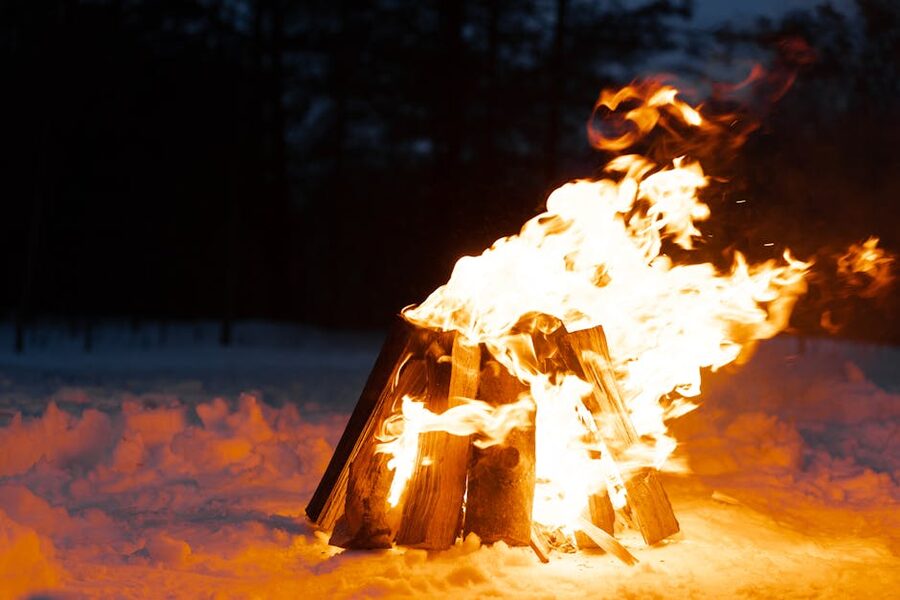
It starts with dinner at home, usually a leg of lamb or a roast pork. Around 8:30 p.m., everyone heads to one of the neighbourhood brennur, the bonfires. Each neighbourhood builds its own, sometimes out of old Christmas trees and scrap wood, sometimes with weeks of planning. There are ten or fifteen around Reykjavik each year, and it’s where you go to see your neighbours, drink hot chocolate or mulled wine from a thermos, and stand in the dark around a fire that’s bigger than a house.
At 10:30 p.m., everyone leaves the bonfires and goes home for Áramótaskaupið, “the New Year’s comedy”, the national satirical broadcast on RÚV. It’s half an hour of sketches riffing on the year’s politicians, scandals, and local figures, and it’s been running every New Year’s Eve since 1966. Watching it is close to mandatory. Even if your Icelandic isn’t strong enough to catch every joke, watching the country watch Áramótaskaupið is a cultural event in itself. The streets are empty between 10:30 and 11:30. Nothing else is open.
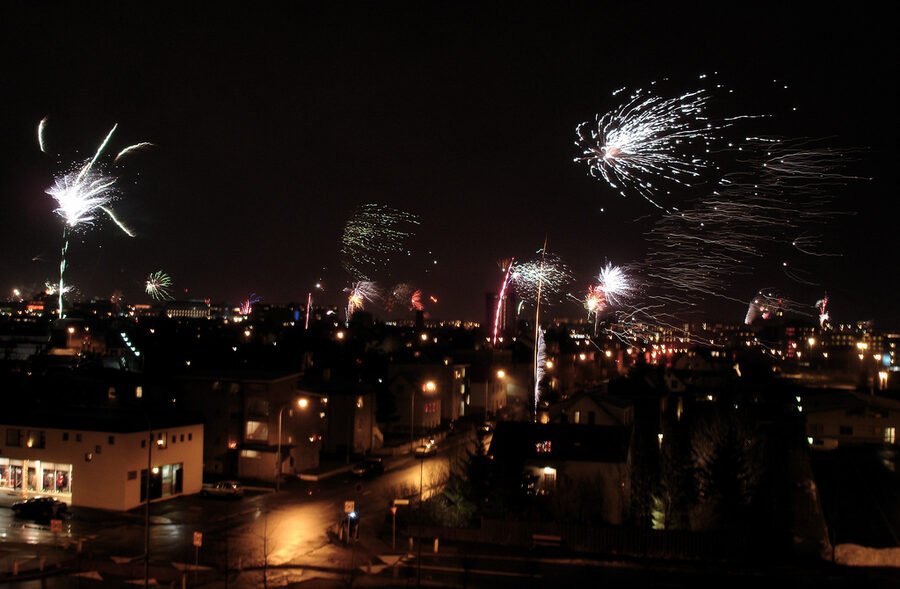
At 11:30, people come outside. Every household has stockpiled fireworks. These aren’t bought at shops, they’re bought from the ICE-SAR (Icelandic Association for Search and Rescue) tents that pop up in mid-December, run by the volunteer rescue teams who come and find you when your hiking trip goes wrong. A family might easily spend 50,000 to 150,000 ISK on fireworks, and all of it goes to the teams. It’s essentially a mass donation drive dressed up as pyrotechnics.
At midnight, everyone lights everything they bought. Reykjavik becomes the loudest, most spectacular and smoke-filled thing you have ever seen. The show lasts an hour, not ten minutes, and the whole city is up on its rooftops or down at Hallgrímskirkja to watch. Bring ear protection if you’re sensitive. Bring a camera if you’re not.
13. Þrettándinn, when the elves come out one more time
The last night of Christmas is the 6th of January. We call it Þrettándinn, “the Thirteenth”, counted from Christmas Day.
It’s when the final Yule Lad, Kertasníkir, heads back to the mountains. The elves come out for their last proper party of the year. The Christmas tree comes down and the lights come off the house the next morning.
The evening itself is a smaller version of New Year’s: neighbourhood bonfires again, fireworks left over from a week before, and sometimes a torch-lit parade of elves and trolls walking through the streets. Some of the bigger ones, in Ísafjörður, Akureyri, and at Heiðmörk outside Reykjavik, draw a proper crowd. People sing, the kids dress up, and the huldufólk, the hidden folk, are said to walk among the living unseen.
Folklore says Þrettándinn is the one night in the calendar when the supernatural is welcome back indoors. Cattle can talk. Seals take off their skins and dance as people. The elves, the “good people”, are briefly visible to the rest of us. And then on the morning of the 7th, everything goes back to winter routine: school, work, grey days, waiting for spring.
If you can, join one of the Þrettándinn bonfires. You won’t need to plan much, just show up at dark. Any small town or Reykjavik neighbourhood will have one running. Bring a thermos.
Before the bonfires, if you still have a Christmas tree up, carry it out and add it to the pile. It’ll go on the fire with the others, and so ends the twenty-six days.
A few practical notes if you’re coming
A quick gathering of the things visitors ask about most, in one place.
Flights. Keflavík is open 24/7 through the holiday, but flights the week before Christmas fill up months in advance and drop in price sharply from around the 28th. If you want to come for the whole thing and fly out on the 6th, book by October.
Accommodation. Most Reykjavik hotels stay open; some smaller guesthouses close for the 24th–25th. A Reykjavik city break during Christmas week runs about 25–40% higher than the shoulder-season average. Outside Reykjavik, especially on the south coast, prices actually drop between the 2nd and the 18th of December, then climb hard through the New Year.
Driving. Don’t rent a 2WD in December. If you’re going anywhere outside Reykjavik, rent a 4WD with studded winter tyres. Fuel is expensive (about 330 ISK per litre last time I filled up), and vegagerdin.is has the live road-condition map you’ll want bookmarked.
Tours. Blue Lagoon, Northern Lights hunts, and Golden Circle day trips all run through Christmas at reduced frequencies. Book a week ahead, minimum, and read our tour guides to pick the operator that matches your schedule. If you want Yule Lad-themed tours for kids, yourfriendinreykjavik.com runs a small group walking tour in December that’s genuinely good.
Language. Learn two phrases. Gleðileg jól, “happy Christmas”, pronounced roughly gle-thee-lake yoal. Takk fyrir, “thank you”, pronounced tahk fih-rih. People will be delighted that you tried, and they’ll be patient if it doesn’t come out right.
And that’s Christmas in Iceland. Twenty-six days, thirteen Yule Lads, a book per person, a cat that inspects the wardrobe, a national bonfire, and a fireworks budget donated to the rescue teams. If you come, come for the whole thing. Gleðileg jól og farsælt komandi ár.