
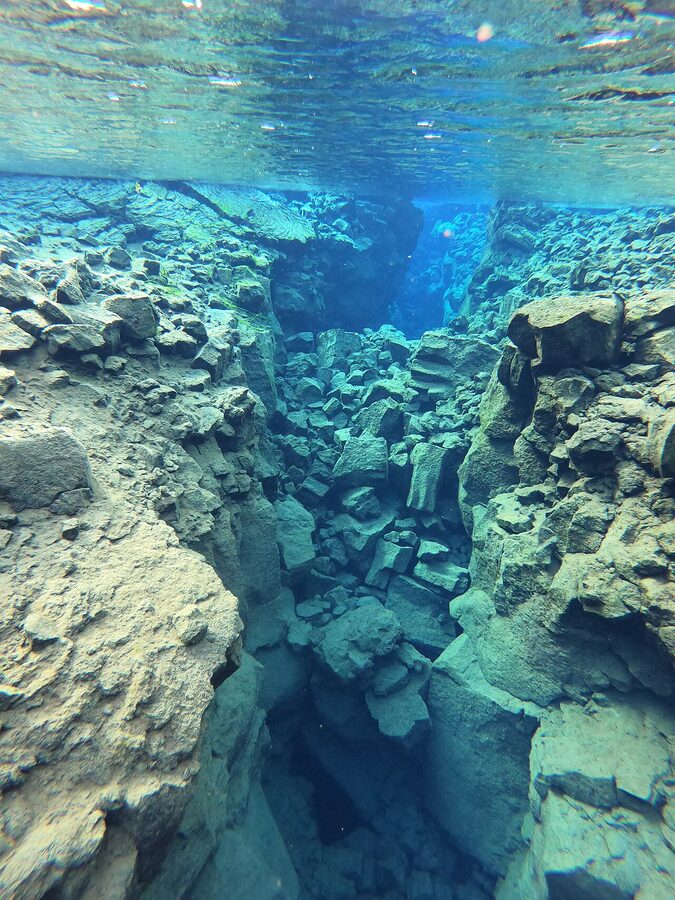
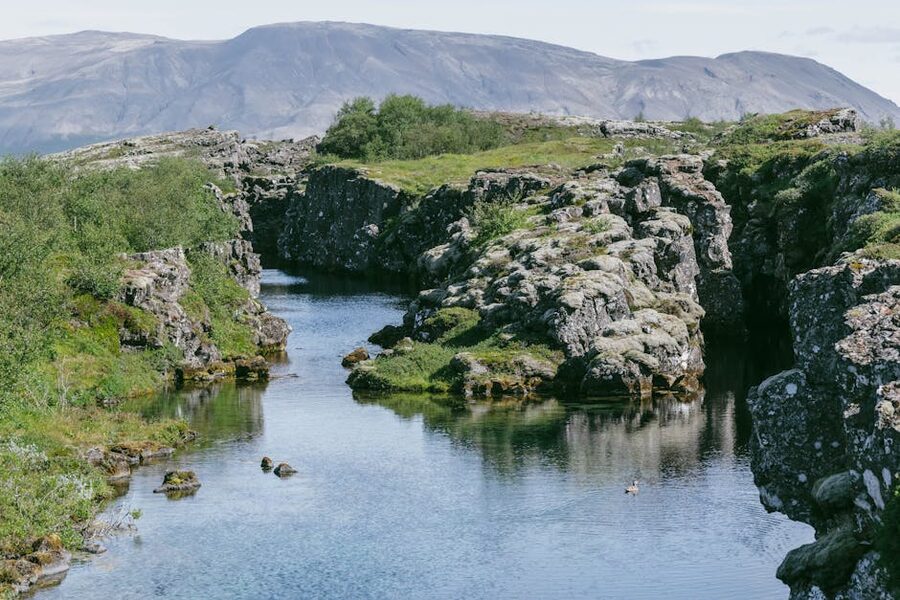
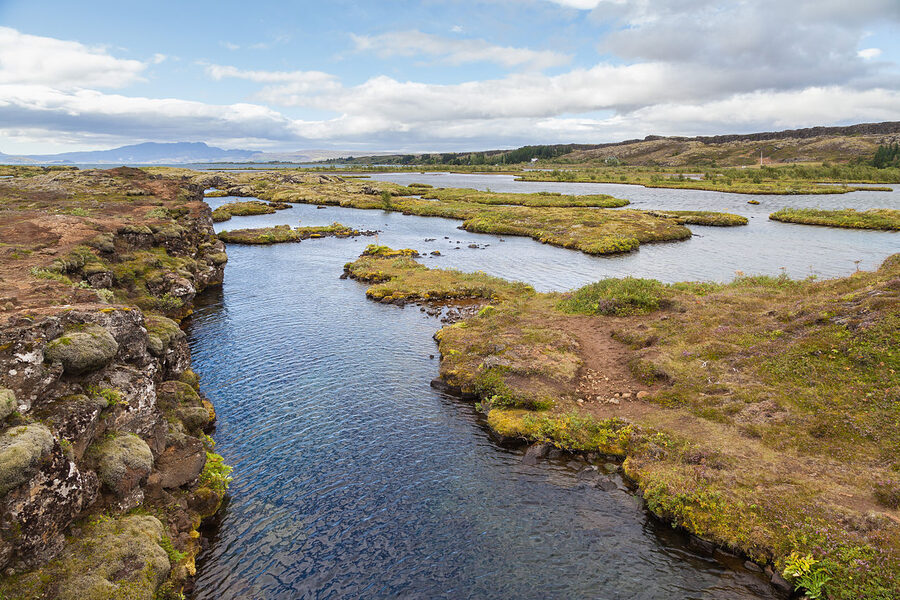
Silfra is the rift. The actual rift. You can stand on a wooden platform on the edge of Þingvellir Lake, look down at what looks like an ordinary little stream, and you are looking at the gap between the North American and the Eurasian tectonic plates. They are moving apart at about two centimetres a year. Over the last few hundred years they pulled this fissure open, glacial meltwater from Langjökull found its way into it after thirty to a hundred years of filtering through porous lava, and now you can put on a drysuit, lower yourself down a metal ladder, and float in some of the clearest fresh water on earth with one hand on Europe and the other on North America. There is nowhere else on the planet you can do that. People keep saying it and people keep thinking it’s marketing copy. It isn’t. It’s just geology.
I’ll get the bias out of the way: I think Silfra is one of the genuinely great experiences in Iceland, and one of the few that really does live up to the photos. The water clarity is ridiculous. On a flat day with a bit of sun you can see clear to the rocky bottom thirty metres down. The colour is a turquoise-green you don’t see anywhere else and don’t quite believe in photographs until you’re in it. Thirty to forty minutes in the water and you’re back in a heated van with hot chocolate. The whole thing takes a morning. Most people who do it remember it years later.
I’ll cover what Silfra actually is and how the geology works, the difference between snorkelling and diving (and which one you almost certainly want), the operators worth booking, what a tour day actually feels like, the rules and restrictions that catch people out, the best time of year, and what I’d skip.
In This Article
- What Silfra is, in plainer terms
- Why the water is so blue
- Snorkel or dive
- Snorkelling
- Diving
- Who runs the tours
- Dive.is
- Arctic Adventures
- Adventure Vikings
- Scuba Iceland and Mountain Guides
- Aggregators and combo platforms
- What a tour day looks like
- Suiting up
- Into the water
- Warming up
- What to wear under the drysuit
- The rules and restrictions that catch people out
- When to go
- Combining Silfra with other things
- Other natural pairings
- Photos and video
- Safety and the realities
- The geology in more detail
- What I’d skip
- What I’d actually do
- The official Þingvellir bits
- Frequent worries, briefly
- The genuine surprises
- Booking, briefly
- Why Silfra is worth thirty minutes of your life
What Silfra is, in plainer terms
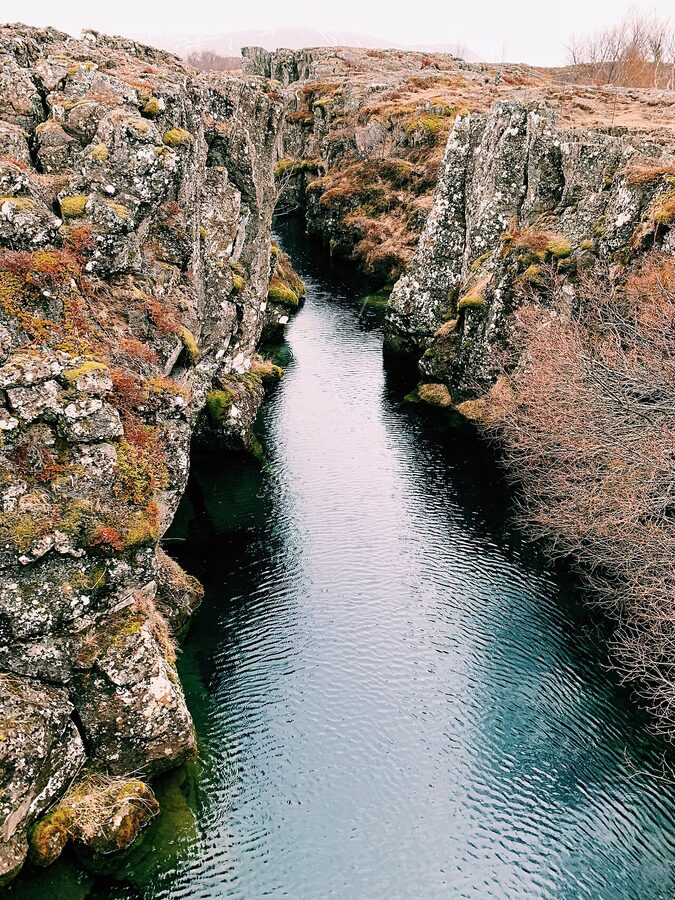
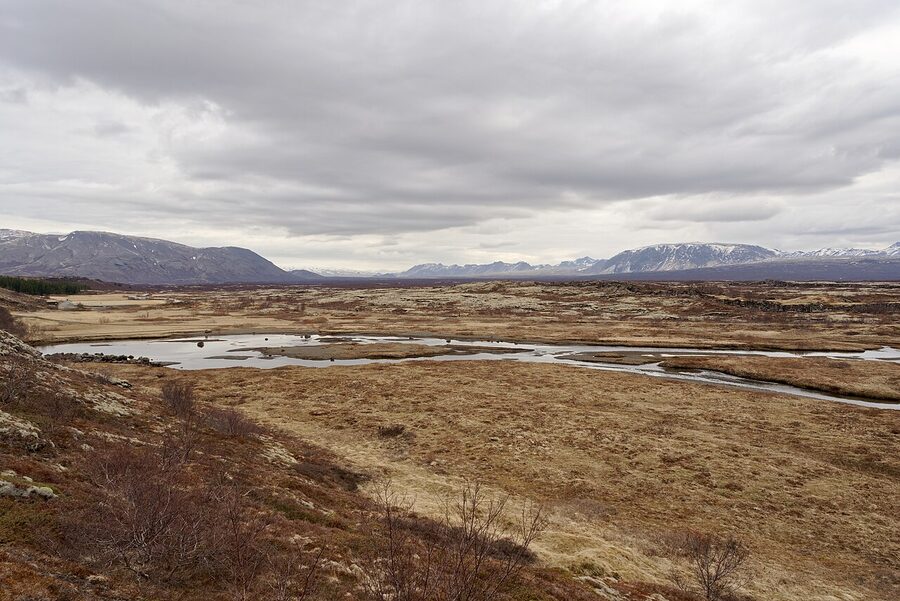
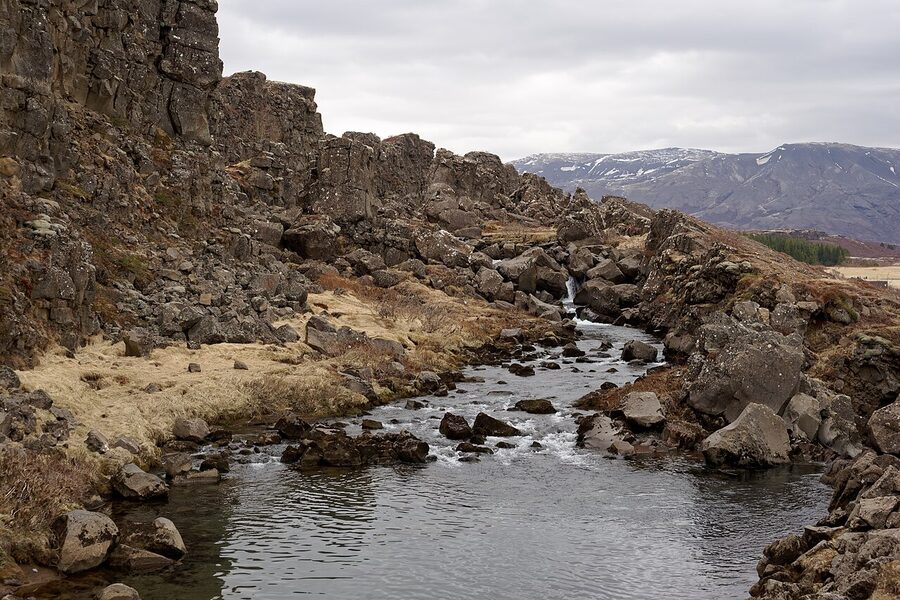
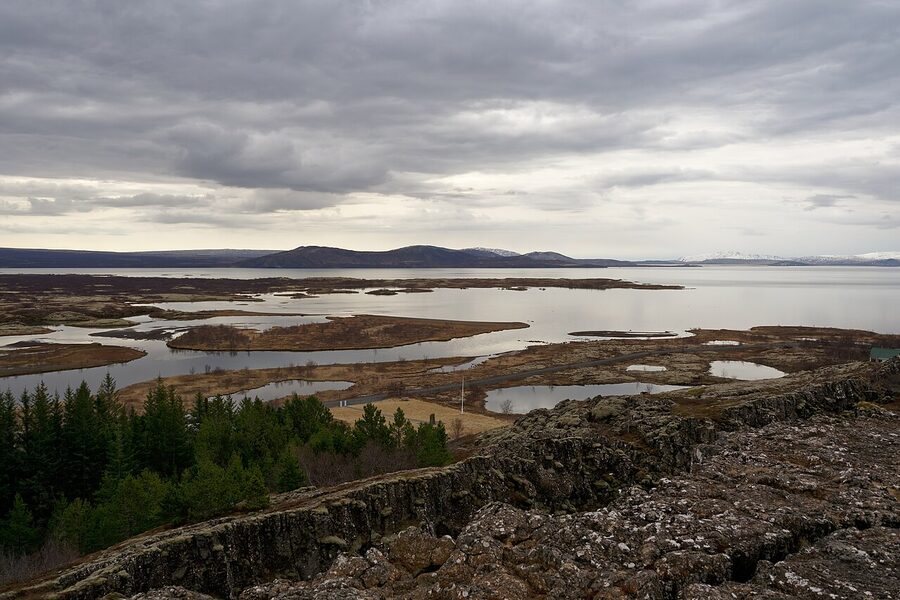
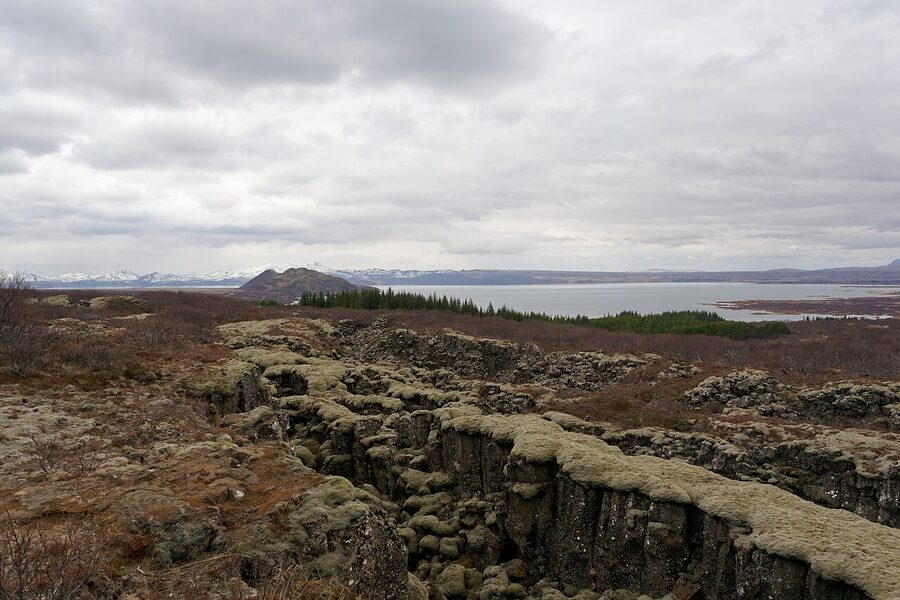
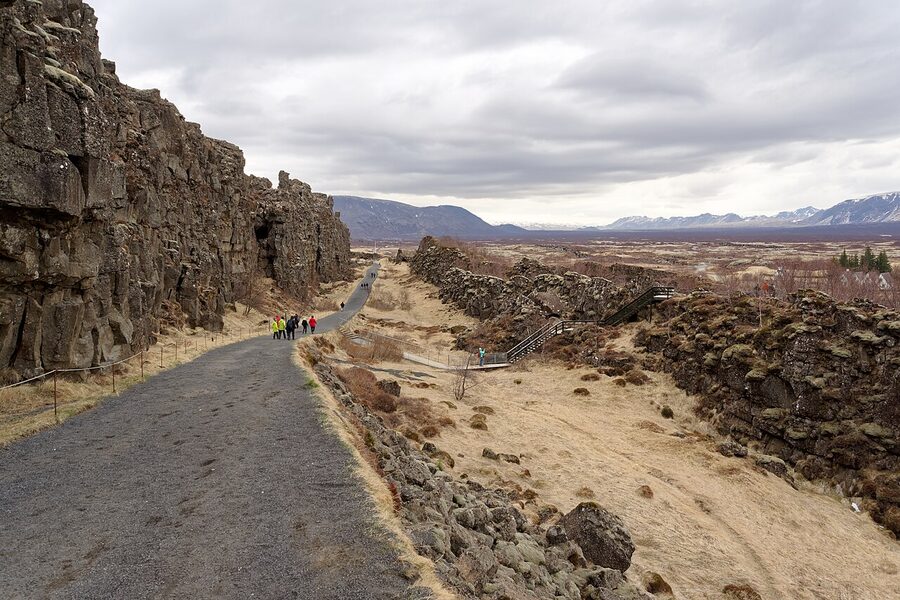
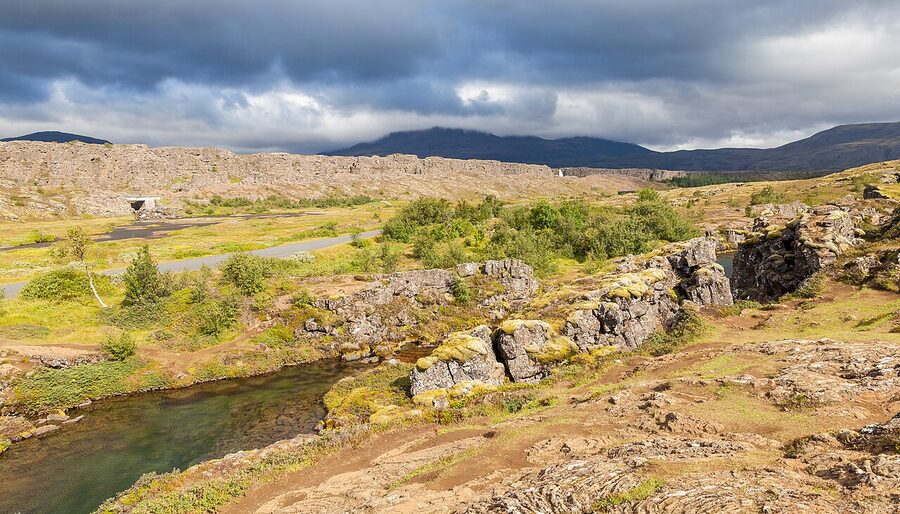
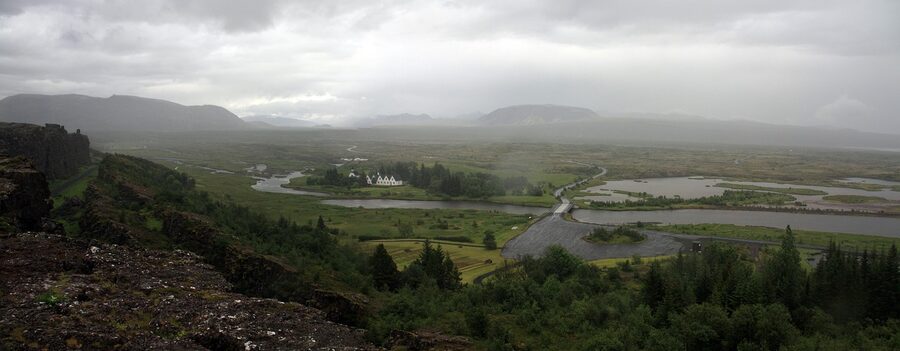
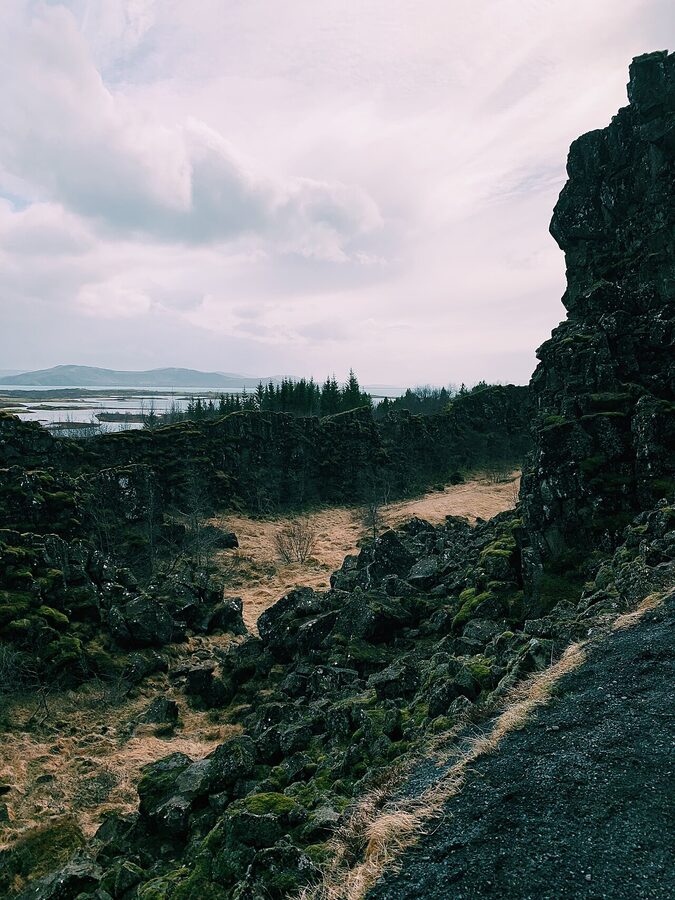
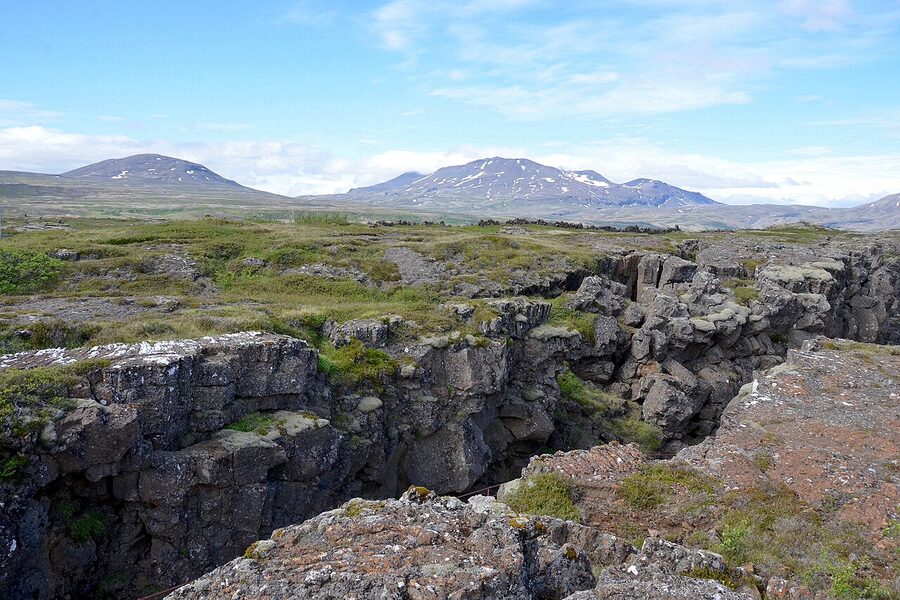
Þingvellir National Park, about an hour east of Reykjavík on Route 36, sits on top of the Mid-Atlantic Ridge. The whole park is a long rift valley, with dark cliffs on the western side (the edge of the North American plate, called Almannagjá) and another set of cliffs further east (the Eurasian edge). The plates are slowly pulling apart, and every century or so a serious earthquake rips a new fissure across the valley floor. Silfra was opened that way in 1789 by an earthquake which dropped the ground around the lake and tore a long crack into the basalt all the way down to the lake bed.
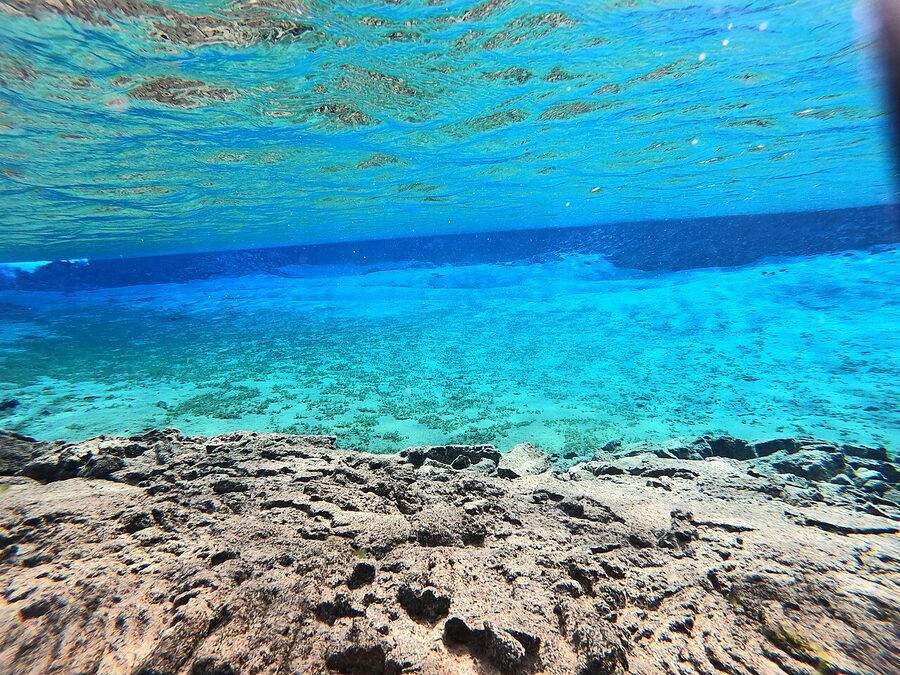
What makes Silfra Silfra (and not just one more crack in the rock) is what the water does. Glacial meltwater from Langjökull, the second-biggest icecap in Iceland, flows underground through about fifty kilometres of porous lava field. The journey takes somewhere between thirty and a hundred years depending on which estimate you read. By the time the water surfaces inside Silfra it has been filtered through that lava the way water gets filtered through coffee grounds, except slower and over a much longer distance. What comes out is impossibly clean. The visibility in the fissure runs to about a hundred metres on a good day; some operators quote a hundred and twenty. You can drink it as you swim. People do. I have. It’s the best water you will ever taste. The temperature stays at 2 to 4 °C year round because it never sees the sun until it surfaces here.
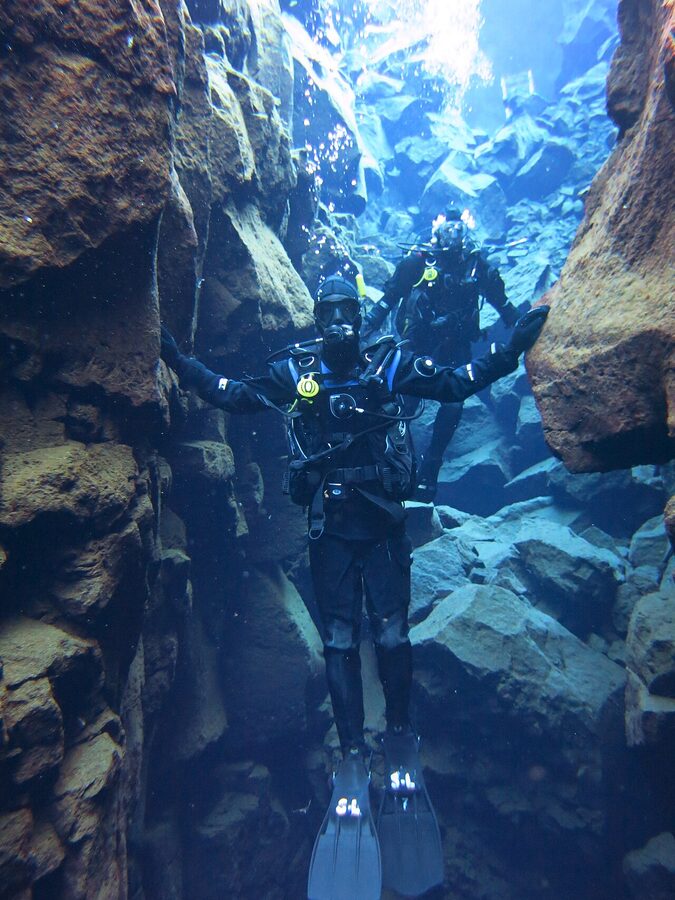
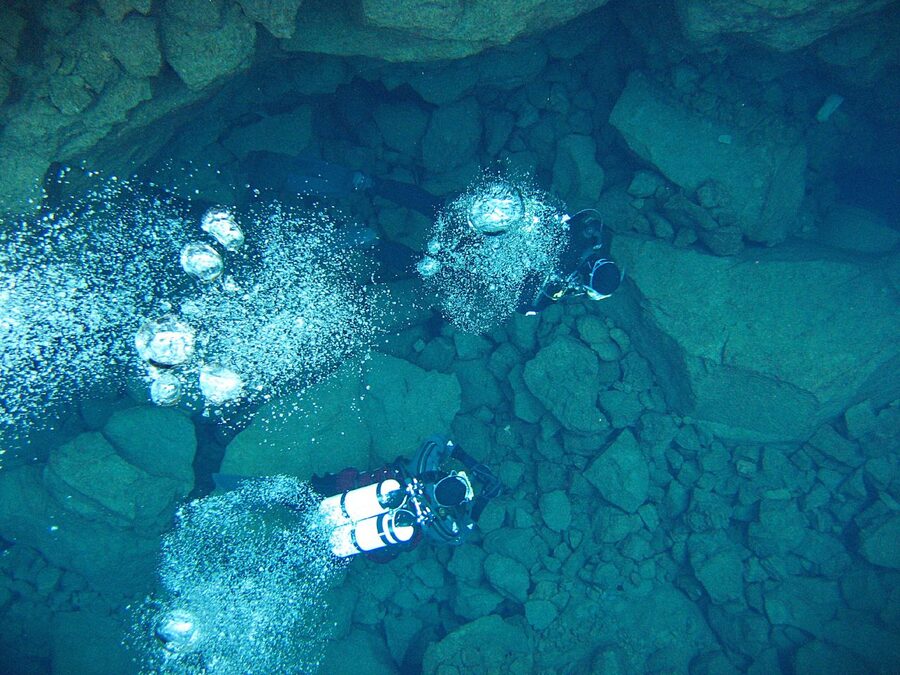
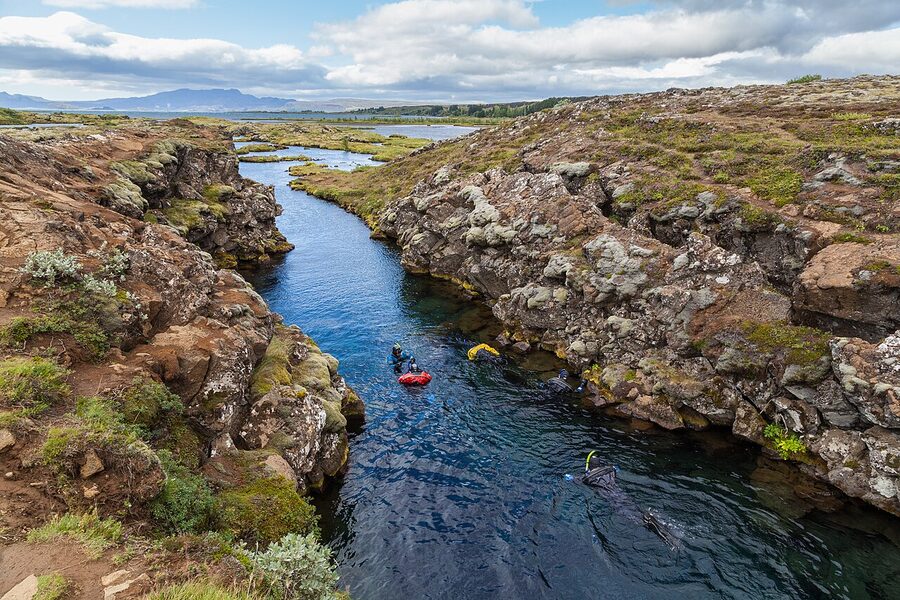
The fissure is not a single straight crack. The route a snorkel tour takes you through has four sections, each different from the next. You’ll start in the narrowest part, called Big Crack, where the walls are so close on either side you can touch them both at once. From there it opens out into Silfra Hall, a wide chamber with white sand on the bottom and visibility you have to see in person to believe. Then comes Silfra Cathedral, the iconic part: about twenty metres wide, a hundred metres long, walls dropping away into deep water beneath you, columns of light from the surface. You exit out into Silfra Lagoon, a wider, shallower bay where the current dissipates and you can climb out up a metal ladder. Total distance covered is about three hundred metres. Total time in water is thirty to forty minutes, depending on how much your guide wants to let the group linger.
Why the water is so blue
Two reasons. First, the water has almost no organic matter or sediment in suspension, so light passes through it almost the way it passes through air. Second, the bottom of the fissure is pale: white silt, light-coloured volcanic ash, pale rock. The blues and greens you see are the longer wavelengths of sunlight reaching that pale bottom and bouncing back through that very clean water. You don’t get the same effect in tropical seas because tropical seas have plankton, salt-induced refraction, and a different bottom palette. The Silfra blue-green is a freshwater, glacier-fed, mid-latitude colour and it’s specific to a handful of places in the world.
Snorkel or dive
Almost everyone reading this should snorkel. I’ll explain why, and when diving makes sense.
Snorkelling
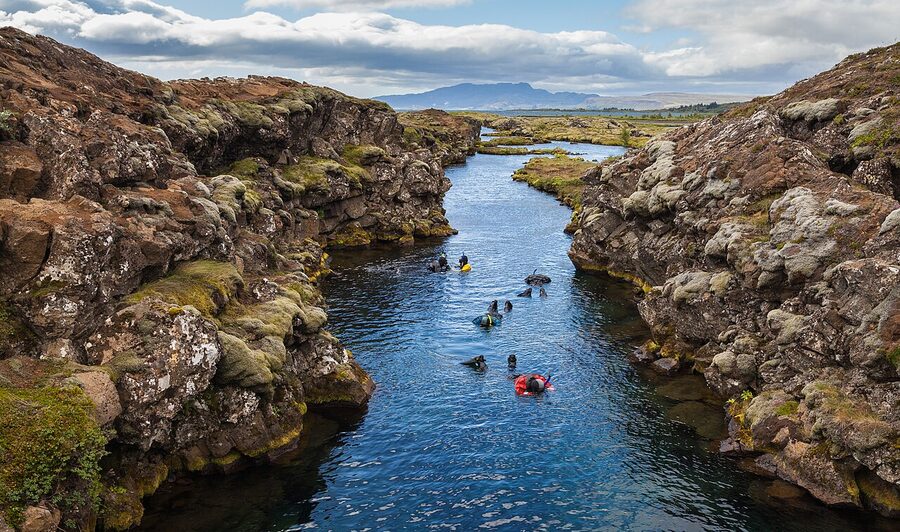
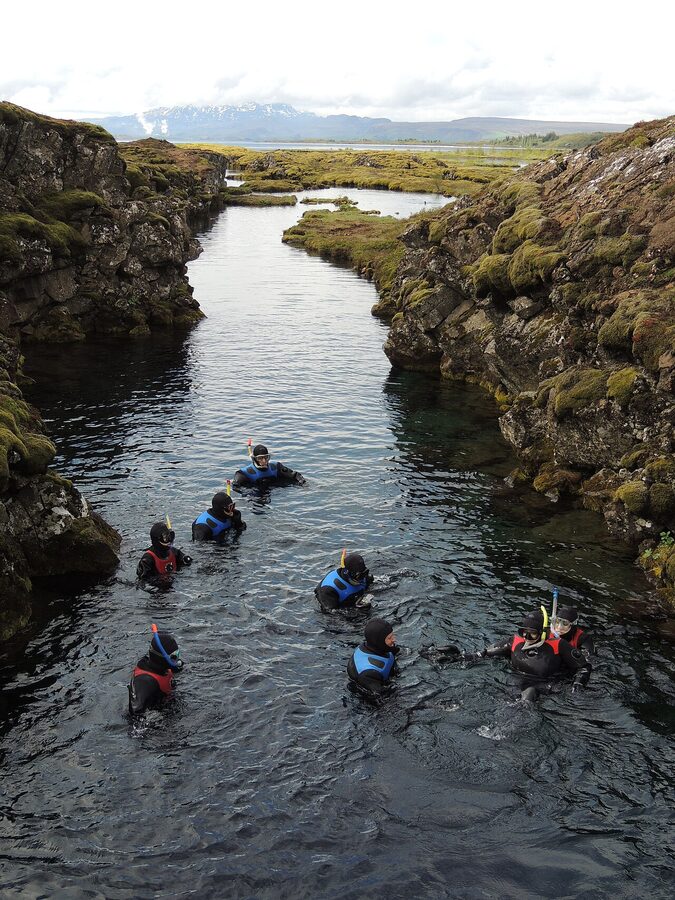
You wear a drysuit (provided), neoprene hood and gloves (provided), mask, snorkel, fins. The drysuit is sealed at the wrists and neck and keeps the cold water out completely; you wear thermals underneath that you bring or rent, and that layer is what keeps you warm. You float on the surface and look down. The current does most of the work; you mostly drift, kicking lightly to steer. You don’t need any certification. You don’t need to have snorkelled before. You do need to be able to swim and be comfortable in water, which most operators define as being able to keep yourself afloat without help and propel yourself with your hands. That’s it.
Cost runs around 17,990 to 22,000 ISK if you self-drive and meet at Þingvellir, and 26,000 to 30,000 ISK if you want pickup and drop-off in Reykjavík included. The whole experience on site is two and a half to three hours: forty-five minutes of briefing and getting suited up, thirty to forty minutes in the water, fifteen minutes of warming up and getting out of the suit afterwards. If pickup is included, allow five to six hours door to door from your Reykjavík hotel.
Diving
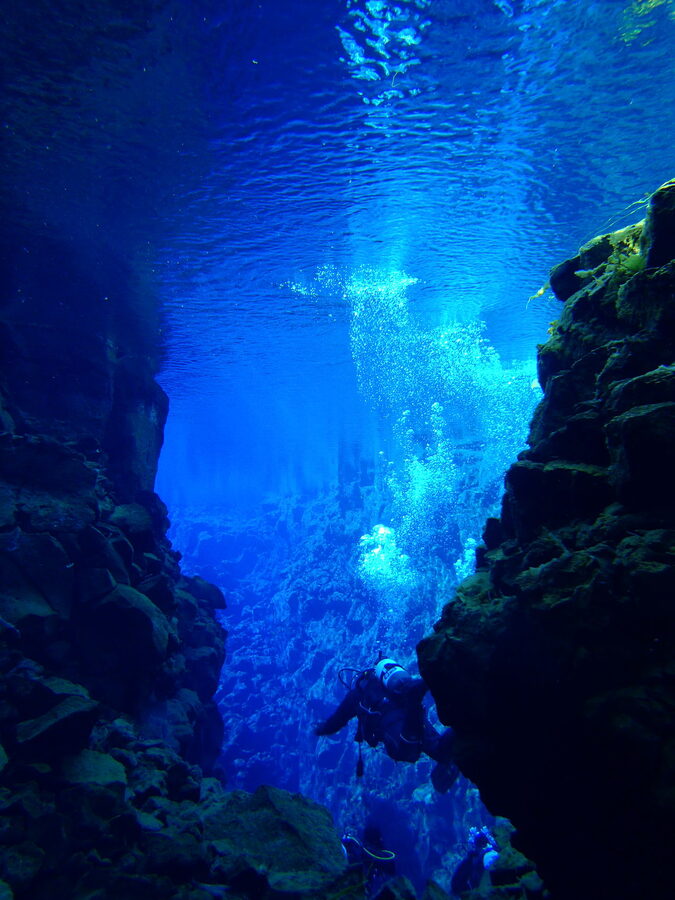
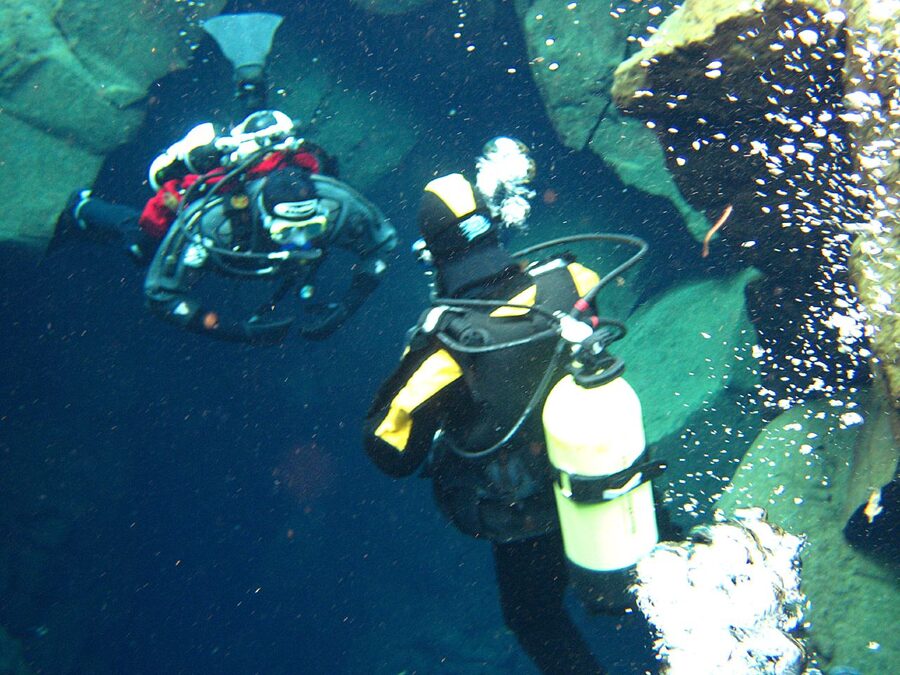
Diving is a different proposition. You go through the same fissure but you go down into it: into the deeper sections of Silfra Hall and Silfra Cathedral, down to the maximum allowed depth of about eighteen metres. The walls drop away below you, the current pulls you along, you see the basalt formations from inside. Diver friends who have done both say it’s a noticeably different experience from snorkelling and worth doing if you’re already certified.
The catch is the certification requirement. To dive Silfra you need a PADI Open Water certification (or equivalent from another agency) and a drysuit certification on top. If you don’t have the drysuit cert, some operators will accept ten logged drysuit dives within the last two years, with written proof from your instructor. Operators have got stricter about this in the last few years because too many people without proper drysuit experience were panicking on entry, and that’s a serious problem in cold-water diving. You will be asked for proof in advance and again on the day. If you can’t produce it, you don’t go. Cost is roughly 40,000 to 55,000 ISK including all gear.
If you’ve never dived in cold water before, Silfra is not the place to start. The drysuit is a different beast from a wetsuit and the consequences of getting it wrong in 2 °C water are real. Dive.is and a couple of other operators run drysuit certification courses in Iceland, but plan a few days for that and try out the suit somewhere less demanding first. For everyone else: snorkel. You see the same surface views, you get the same continental-plates moment, you spend a fraction of the money, and you don’t need any qualifications.
Who runs the tours
Þingvellir National Park is a UNESCO World Heritage site and Silfra is a protected dive site within it, so you cannot legally rock up with your own gear and get in. You go with one of the licensed operators or you don’t go. There are four worth knowing about and one combination tour worth flagging.
Dive.is
Dive.is is the biggest and the most polished. They’re a PADI 5-Star resort, they run multiple tours a day in summer (and most days in winter), and their Silfra Snorkelling Day Tour has been on Tripadvisor’s “Best of the Best” list for several years running. Their setup at Silfra is the most professional: a heated changing van that means you don’t strip down outside, hot chocolate and cookies on the way out, photos available for purchase from the guide for around 3,000 ISK. Maximum group size is six per guide. Snorkel tour from around 17,990 ISK self-drive or 26,980 ISK with pickup. They’re also the largest dive operator at Silfra by some margin and run multi-day dive packages around the country. If you want the smoothest experience and don’t mind being one of forty people on site that morning, this is the pick. If you’d rather a smaller-feeling group, see below.
Arctic Adventures
Arctic Adventures runs the second-largest Silfra programme. They have daily departures, similar pricing to Dive.is, and a slightly more adventure-tour vibe (they also run glacier hikes, Northern Lights tours, ice cave trips). The product is broadly the same: thermal onesie under the drysuit, ladders into the water, thirty-odd minutes of drifting through the four sections, hot drinks at the end. Their guides tend to be experienced and the safety standards are good. I’ve had several friends go with them and the consistent feedback is that they’re solid; the tour is busy in summer but well-run. Their booking platform also sells combo tours that pair Silfra with the Golden Circle (Geysir, Gullfoss, Þingvellir walking), see the combo section below for whether that’s a good idea.
Adventure Vikings
Adventure Vikings are smaller and a bit cheaper. Their gimmick is they’re the only operator who’ll let you snorkel Silfra in a wetsuit (most use drysuits exclusively). The wetsuit option is for people who already have cold-water experience and want a different feel; for most travellers the drysuit is what you want. Their drysuit snorkel runs around 18,500 ISK self-drive, which is at the cheap end. Group sizes are smaller, the tour feels less assembly-line, and reviews are good. If Dive.is and Arctic Adventures are sold out for your dates (it happens in July), this is a real alternative, not a fallback.
Scuba Iceland and Mountain Guides
Two more in the rotation. Scuba Iceland is a small operator with a more personal feel, useful if you want a quieter morning. Icelandic Mountain Guides run a self-drive snorkel tour as part of their broader programme; they’re an established multi-day expedition company so the safety standards are excellent, but they’re not specialists at Silfra the way Dive.is is.
Aggregators and combo platforms
You can also book Silfra through international platforms: GetYourGuide, Viator, Klook, Guide to Iceland. They re-sell the same operators, sometimes at the same price. Benefit: unified booking, one-click cancellation. Downside: you’re another step removed from the operator if anything goes wrong. I’d default to booking direct, but the platforms are fine if you’re booking five things in one trip.
What a tour day looks like
If you’ve booked a pickup tour, you meet your driver at a central Reykjavík stop or your hotel between roughly 08:00 and 10:00 depending on the slot. The drive to Silfra takes about an hour. Use the toilet at a rest stop on the way; facilities at Silfra are minimal.
If you’re self-driving, take Route 1 north out of Reykjavík, then Route 36 east. Park in the P5 car park (the snorkel and dive lot) on the lake side, five minutes walk from the meeting point. Þingvellir charges a flat 1,000 ISK per car for the day, payable online via the CheckIt app. Cameras read your number plate, so don’t skip it.
Check in fifteen minutes before your tour time. The team ticks you off, hands you a gear bag, splits the group into parties of six per guide.
Suiting up
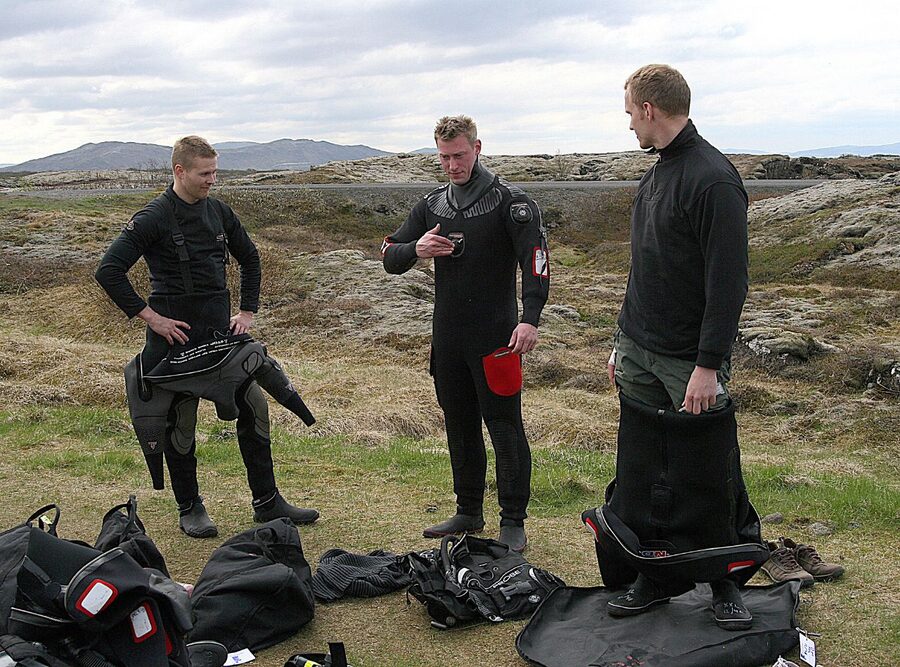
The longest part of the day and the part most people remember. You strip down to your base layer (thermal top and bottom, thick wool socks, brought from home or borrowed from the operator). On goes a thermal onesie. Then the drysuit: heavy, baggy, with built-in boots and tight rubber seals at the wrists and neck. The trick to getting through the neck seal is baby powder on your hands and ears, and a guide who’s done this a thousand times helping you wiggle through. Everyone looks ridiculous. Don’t worry about it.
Once the suit is on, the guide checks the seals, helps with the hood (7 mm neoprene, only your face exposed), then mittens, mask, snorkel, fins. By the end you can barely bend your elbows and walking in fins is silly. This is fine. You’re not doing it for long.
Into the water
The walk to the entry platform is two hundred metres along a gravel path, fins in hand. You sit on the platform, shuffle your fins on, and then climb down a set of metal steps about three metres into the water. The first thing your face does when it hits 2 °C water is hurt. It’s a sharp ice-cream-headache pain across the forehead and bridge of the nose for fifteen to thirty seconds. Then your face goes numb and you stop noticing. Most people are surprised that the rest of them feels fine; the drysuit really does work. Your hands eventually get cold over the course of the snorkel because the gloves are wet neoprene rather than sealed, but that’s at the very end.
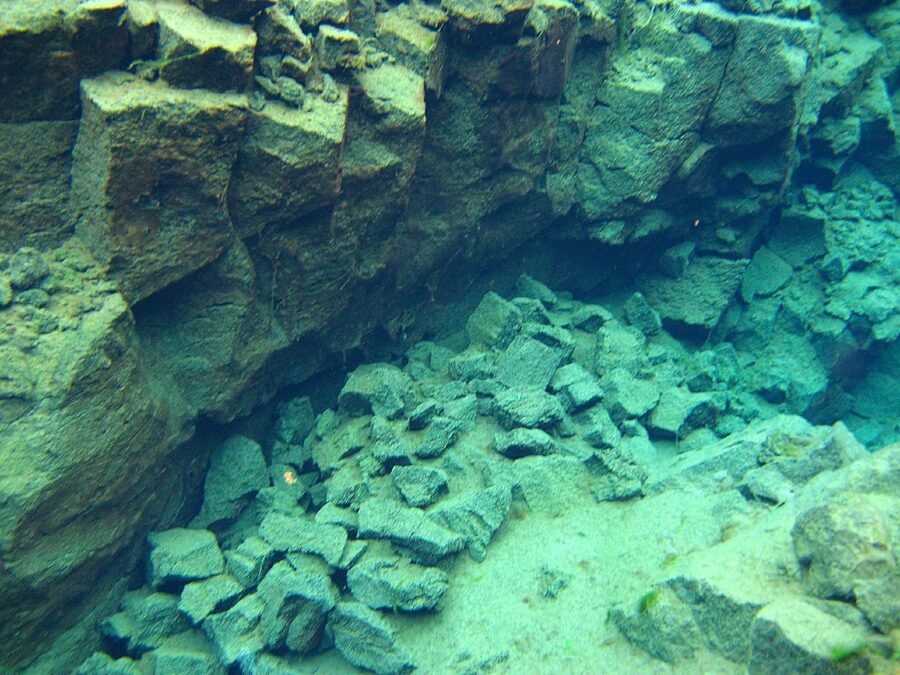
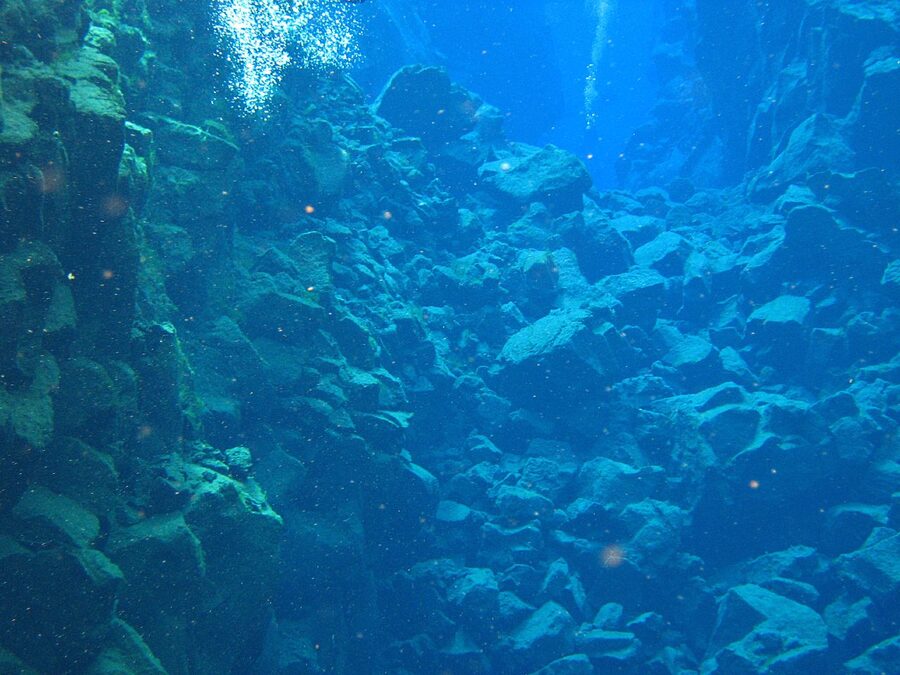
The first thing you’ll see when you put your face under is the bottom. Of the fissure. Thirty metres down. In perfect detail. The clarity is the part of Silfra that genuinely cannot be conveyed in a photograph. You can see individual stones the size of a fingernail on the bed; you can see the lines of glacial silt; you can see the columns of basalt down the walls; you can see the divers below you as if you were ten feet apart. And you are floating between two cliffs that are twenty centimetres of crack in some places and thirty metres of opening in others.
The current is gentle. Most of the time you barely have to kick. Your guide leads from the front and you string out behind, occasionally raising your head to listen for instructions. The classic photograph is in Big Crack with one hand pressed against each wall, Europe and North America in the same picture, both touching distance. The walls are mossy and basalt-brown; the water between them is the colour of nothing else.
You drift through Big Crack, into Silfra Hall (the wide chamber where the colour really registers), then into the Cathedral (the deep, long section with the iconic light columns), and finally out into the Lagoon, which is shallower and brighter and where the current relaxes. The whole thing is between thirty and forty minutes. Climb out up another metal ladder, fins off on the platform, and walk back to the meeting point with the gear on.
Warming up
Back at the van, you peel out of the drysuit (much easier than getting in), get back into your warm clothes, and the guide hands round hot chocolate and biscuits. Twenty minutes, give or take. The cold doesn’t really hit you while you’re in the water; it hits you afterwards, when the wind catches your wet head as you walk back. Wear a beanie for the walk if you’ve got one. The hot drink helps a lot. So does sitting in the heated van for a bit.
What to wear under the drysuit
The question that gets asked the most and that operators answer least clearly.
Bring a thermal base layer (top and bottom), thick wool or synthetic socks, and a beanie. That’s it. Base layer should be merino, wool, or a decent synthetic; cotton is a bad idea because if any moisture gets in, it stays cold. Nothing too tight; the drysuit will compress everything. The operator-provided thermal onesie goes over your base layer, and the drysuit goes over that.
The drysuit has built-in boots and you wear thick socks inside; your normal shoes you change out of in the changing van. Bring a small towel for after, your hair will be damp from the hood liner.
What not to wear: cotton, anything tight enough to bunch up under the suit, jewellery, watches. Glasses don’t fit inside the mask. Contact lenses work and are the standard solution. If you can’t tolerate contacts, some operators have prescription mask inserts; ask in advance.
The rules and restrictions that catch people out
A surprising number of bookings get cancelled on the day because someone didn’t read the small print.
Age. Most operators require you to be at least twelve years old and at least 45 kg / 99 lb. A few take younger with parental supervision. Under-18s need an adult on the tour.
Weight and height. The drysuits come in fixed sizes and the seals have to fit; anyone outside roughly 45–120 kg or 150–200 cm may not have a suit that works. If you’re at the edges, contact the operator directly before booking.
Health. You can’t snorkel if you’re pregnant. Heart conditions, asthma, certain neurological conditions, and previous strokes are also disqualifying or require a doctor’s note. Anyone over 60 needs a recent medical statement; anyone over 70 may not be allowed at all by some operators. Read the medical waiver before you book.
Swim ability. You don’t need to be a strong swimmer, but you do need to keep yourself afloat without help and be comfortable putting your face under. The drysuit is buoyant, you’ll float without trying, but if open water makes you panic, this isn’t the day to face it.
English and alcohol. The safety briefing is in English; bring a fluent friend if yours isn’t strong. Don’t show up hung over: cold water dehydrates you fast and a fragile head under a tight drysuit is miserable. Obvious; people still do it.
When to go
Year round. The water in the fissure is 2 to 4 °C in January and 2 to 4 °C in July. It does not warm up. The visibility doesn’t really change either. The variations are all about what’s happening above the surface.
Summer (June to August) is busy. Tours run continuously from 08:00 until late afternoon; on a sunny July day there’ll be a queue at the entry platform with three or four groups in sequence. Light is at its best and air temperature is 12 to 18 °C, so getting suited up outside isn’t bad. The prettiest version of Silfra in photographs.
Shoulder season (April–May, September–October) is my pick. Fewer crowds, plenty of daylight, bearable air temperature, you might get the place nearly to yourselves on a quiet weekday. Pricing is the same.
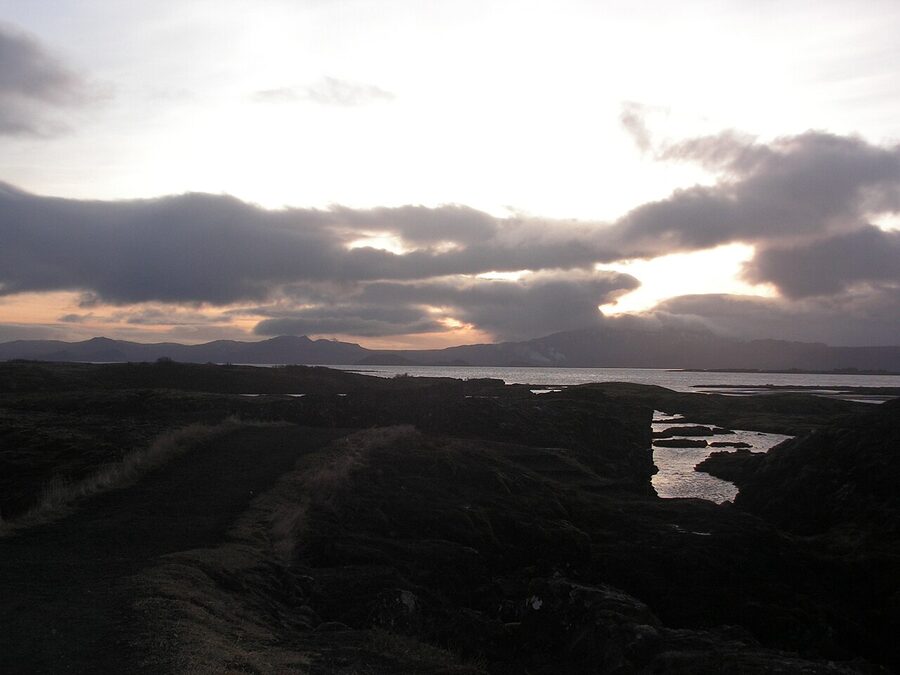
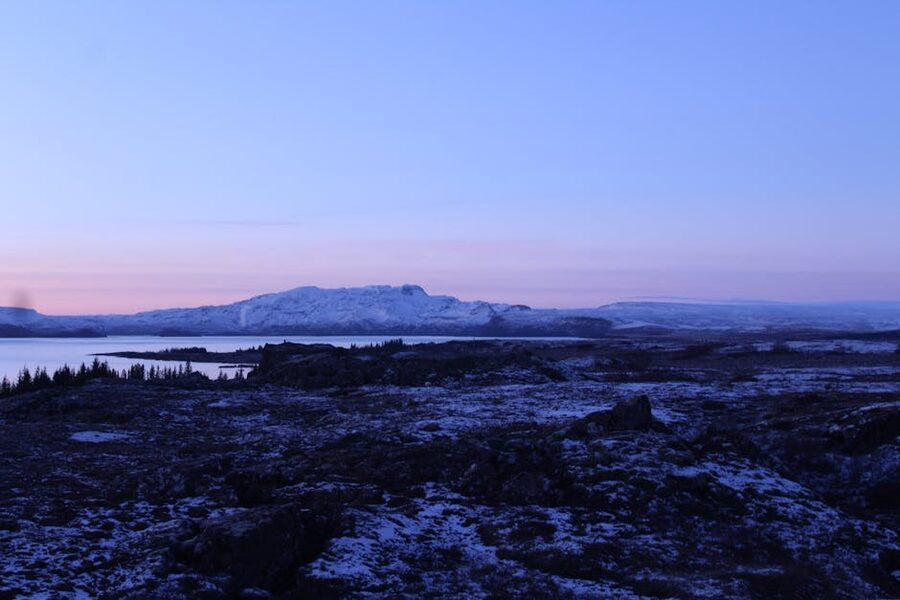
Winter (November–March) is colder above the surface but the snorkel itself is unchanged. The novelty: wading into 2 °C water with snow on the lava rocks around you. The downside is daylight, a tour starting at 11:00 in December leaves you driving back at sunset (15:30). Always check the forecast at en.vedur.is the night before and road conditions at road.is in the morning.
One winter perk: a few operators offer Aurora Snorkel tours that combine an evening Silfra session with a Northern Lights drive afterwards. Long evening, more expensive, aurora never guaranteed, check the forecast at en.vedur.is. If the sky’s clear and KP is forecast at three or higher, it can be a memorable night. If it’s cloudy, you’ve snorkelled and then driven through fog. Manage expectations.
How far ahead to book. Peak July weekends, four to six weeks. Rest of summer, two to four. Shoulder season, one to two. Winter, a few days is often fine, especially mid-week.
Combining Silfra with other things
People with limited days try to bundle Silfra with the Golden Circle and an evening hot springs stop. Operators are happy to sell you the bundle. I would not, on most days.
The Golden Circle (Þingvellir, Geysir, Gullfoss, plus often Kerið crater) is a five-to-seven-hour drive on its own if you do it properly. Silfra is a three-to-four-hour commitment. Trying to do both in a day means you’re rushed at every stop, you skip the Þingvellir walk that’s the most interesting part of the park, and you arrive at Geysir at the worst time of day for crowds.
If you do want a packaged version: the Silfra-plus-Golden-Circle full-day combo runs 35,000 to 45,000 ISK and bundles everything into one bus. Worth it if you have a single day in Iceland; not worth it if you have time to do them separately. For a properly planned visit, see our Golden Circle drive guide.
Other natural pairings
If you’re at Silfra with an afternoon, the better follow-up than rushing to Geysir is one of the soaks nearby. Laugarvatn Fontana is thirty-five minutes east with thermal pools right on the lake, a warm contrast to the cold morning swim. Or save the lagoon for the way back: Sky Lagoon an hour southwest, or the Blue Lagoon if you’ve got a flight to catch. The cold-then-hot sequence is the most Icelandic thing you can do in a day. Soak options in detail in our Iceland hot springs guide.
Photos and video
The truth about photos: pay the operator for theirs. Here’s why.
The drysuit gloves are 7 mm neoprene mittens. You can barely move your fingers, much less press a phone screen or operate a camera dial. Phones in waterproof cases technically work but you can’t see the screen properly through fogged-up plastic. People drop phones into Silfra every season. They are not coming back; the lake bed is thirty metres down.
The guides on most tours carry GoPros and take photos of every snorkeller throughout the route. Dive.is offers them at around 3,000 ISK on the day. Arctic Adventures includes them in some tours and sells them as an add-on in others; budget 2,500 to 5,000 ISK. You’ll get five to fifteen usable shots including the iconic between-the-plates one, emailed the same day or the next.
If you’re bringing your own kit: a GoPro on a small wrist mount or pole is what works. Bring spare batteries, cold water hammers them. Set it to wide-angle, leave it recording, accept that you’ll be editing later. Drone shots are not allowed; the whole national park is a no-fly zone and rangers will fine you on sight.
Safety and the realities
Silfra is not dangerous in any normal sense, but it is not risk-free either, and the operators are appropriately serious about it.
The most common medical issue at Silfra is panic. Someone gets in the water, the cold hits their face, the drysuit feels constricting, and they decide they want out. This happens to one or two people per week in season according to guides I’ve spoken to. The guide brings them straight to the platform, helps them out, and the rest of the group continues. No shame in it. If it happens to you, just say so.
There have been four deaths at Silfra since 2010, all snorkellers, all linked to underlying cardiac issues that worsened in the cold water. None were equipment failures. Operators now require medical waivers from anyone over 60 and won’t accept anyone with known heart conditions; this is why. The good operators (Dive.is, Arctic Adventures) have safety protocols including surface support staff, defibrillators on site, and clear evacuation paths. Cheap operators with rapid turnarounds and big groups have less margin. This is the part where I’d pay 5,000 ISK extra to go with a name.
For real-time safety conditions across Iceland, check safetravel.is before any day trip. They have a 112 alert app worth installing if you’re driving anywhere outside Reykjavík.
The geology in more detail
If you’re the kind of person who reads the museum panels, here’s what’s actually happening under your fins.
Iceland is the only place in the world where the Mid-Atlantic Ridge surfaces above sea level. Everywhere else the ridge is two to three kilometres below the ocean. In Iceland it pokes out, and the ridge is splitting the country in two: the western half (with Reykjavík on it) sits on the North American plate; the eastern half sits on Eurasia. The two are pulling apart at about 2 cm per year, although the strain doesn’t release evenly, with long periods of calm punctuated by big rifting events.
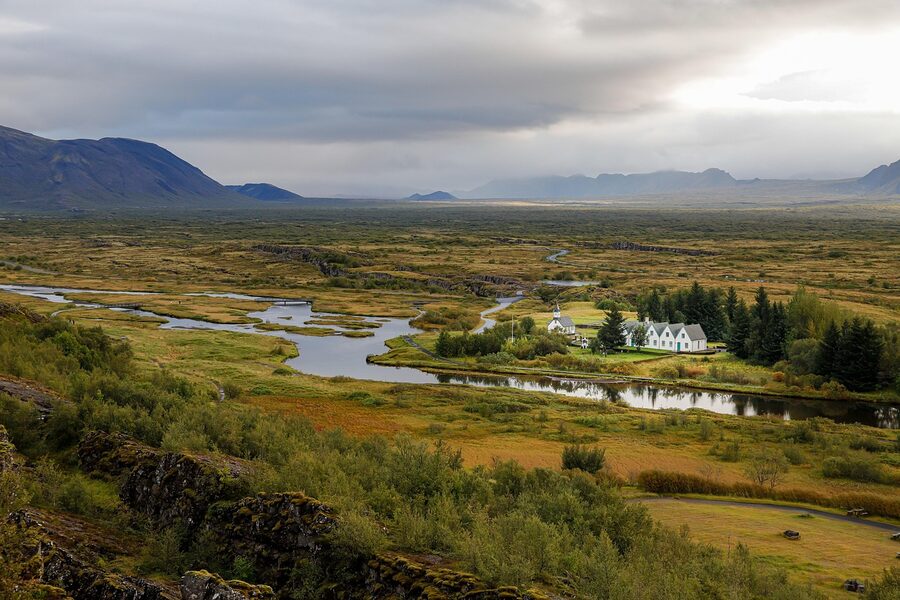
The fissure called Silfra opened up in a major earthquake on 14 June 1789. The same earthquake dropped the floor of the rift valley by several metres and tore Silfra and a number of other fissures across the area. Silfra was the one that happened to intersect the path of an underground spring fed by Langjökull glacier; that’s why it filled with the clear cold water rather than just being a dry crack in the rock. For a wider overview of how Iceland’s fire-and-ice geology works, our Iceland geology guide covers the volcanism, glaciers, and ridge dynamics in depth.
What I’d skip
Private snorkel tours at around 170,000 ISK for a small group. Unless you’re a film crew, this is a lot of money for the same experience with fewer strangers in the photo. The standard tour is already small (six max per guide) and the strangers are usually delightful.
Drone-photo packages. Drones are banned in Þingvellir National Park. Skip.
The Silfra-plus-Golden-Circle-plus-Sky-Lagoon mega-day. Fourteen hours on a bus. Pick two of three at most.
Wetsuit snorkel tours unless you specifically have cold-water-wetsuit experience. Your face still goes numb, your core gets cold faster, and you spend the back half of the snorkel uncomfortable. The drysuit is the right tool. Use it.
What I’d actually do
If I had one morning in Iceland and wanted to make it count, here’s the version of the day I’d book.
I’d take the early-morning Silfra snorkel from Dive.is, with pickup from Reykjavík (around 26,000 ISK). They’re polished, the heated van is a real upgrade in winter, and being one of the first groups in the water means you get the still water before the silt is churned up. Plan to be in Þingvellir for 09:00, in the water by 10:30, back at the van by 12:00.
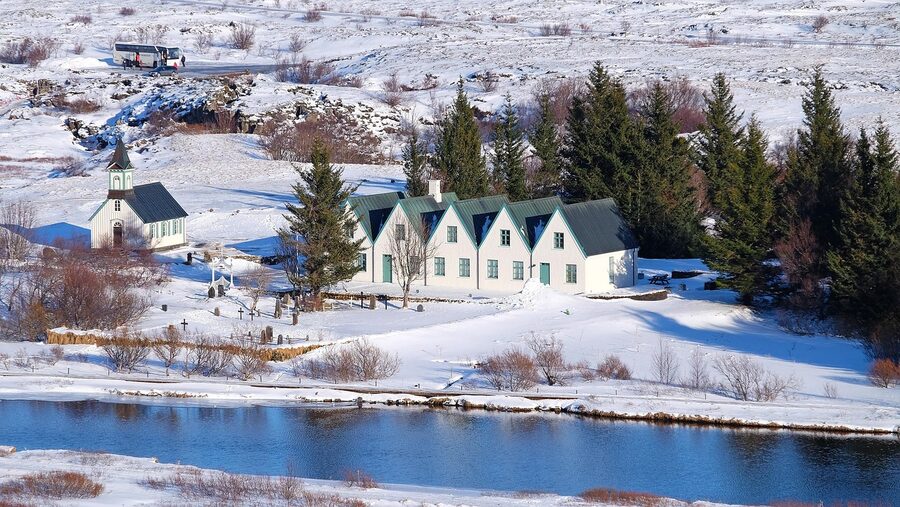
From there I’d skip the bundled Golden Circle option. Ask the driver if they can drop you at the Þingvellir visitor centre rather than driving back immediately, walk Almannagjá to the Lögberg viewpoint (an hour out and back including a stop at Drekkingarhylur and the church), eat the sandwich at the café, and get a shuttle back to Reykjavík (about 12,000 ISK through your hotel). You’d be back in the city by mid-afternoon. Total day cost: around 40,000 ISK including transport and lunch.
If you’ve got a second day, the Golden Circle with a rental car at your own pace is much better than rushing it from a tour bus. The tour roundup covers the rest of what’s worth booking, and the photo tour guide has specifics on the right times and angles for Þingvellir.
The official Þingvellir bits
The Þingvellir National Park visitor centre sits on the western edge of the rift, on top of Almannagjá cliff. Free parking up there (P1 and P2 lots) and a free interpretive centre with displays on the geology, the history of the Alþing, and the wildlife. From there a wooden walkway descends through the cliff into the rift floor and you can walk south to Lögberg (the Law Rock) and the church, or north along the cliff. In winter paths are cleared but icy patches happen.
The park’s own Silfra page has the official rules, the licensed operators list, and the parking fees. The most authoritative single page on what’s allowed; read it once before booking.
Frequent worries, briefly
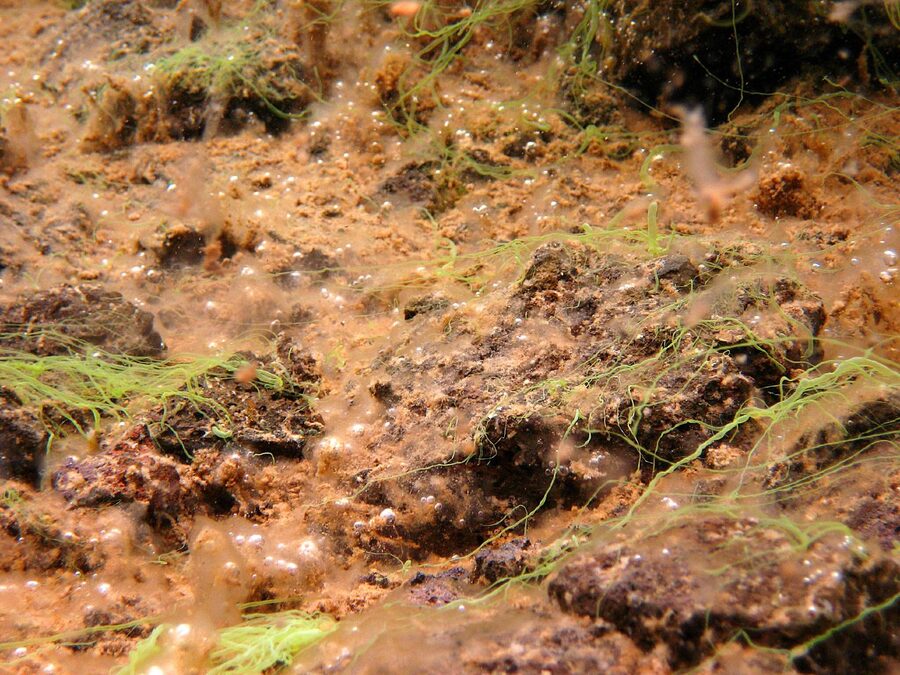
Will I see fish? No. Silfra has no fish; the water is too low in nutrients. The only living things are some hardy algae that bloom on the bottom in summer. The geology is the show.
Is it crowded? In July on a clear morning, yes. Up to four groups of six in the water in close sequence. In winter and shoulder season often you’ll have it nearly to yourself. First slot of the morning is usually the quietest.
Can I snorkel with a head cold? Snorkelling, yes (you stay at the surface so pressure isn’t an issue). Diving, no. If you wake up congested, mention it to the guide.
What about kids? Twelve and up at most operators, eight at a couple, with parental supervision. Kids under fourteen often find the cold harder than adults. For more on travelling with kids, see our family travel guide.
The genuine surprises
The cold doesn’t really bother you in the water. The cold bothers you on the walk back and again in the hour afterwards while your core re-warms. Bring a beanie and a warm coat for the walk to the changing van and the drive home. You’ll be quietly cold for an hour and then suddenly fine.
The clarity is the actual surprise. The colour you can sort of imagine from photos. The clarity, being able to see another snorkeller fifty metres away as if they were five metres, is the part that doesn’t translate. It’s the closest most of us will get to swimming in air.
You will get tired. Not from the swimming (which is gentle) but from the suit, the cold, the gear, the build-up of small stresses. Plan a relaxed afternoon. Don’t book a Northern Lights tour the same evening; you’ll be wiped.
The drinking-the-water thing is real. Your guide will encourage you to take a sip through your snorkel. It tastes like nothing in a way that’s strangely shocking; most water has a faint flavour of something. This doesn’t.
Booking, briefly
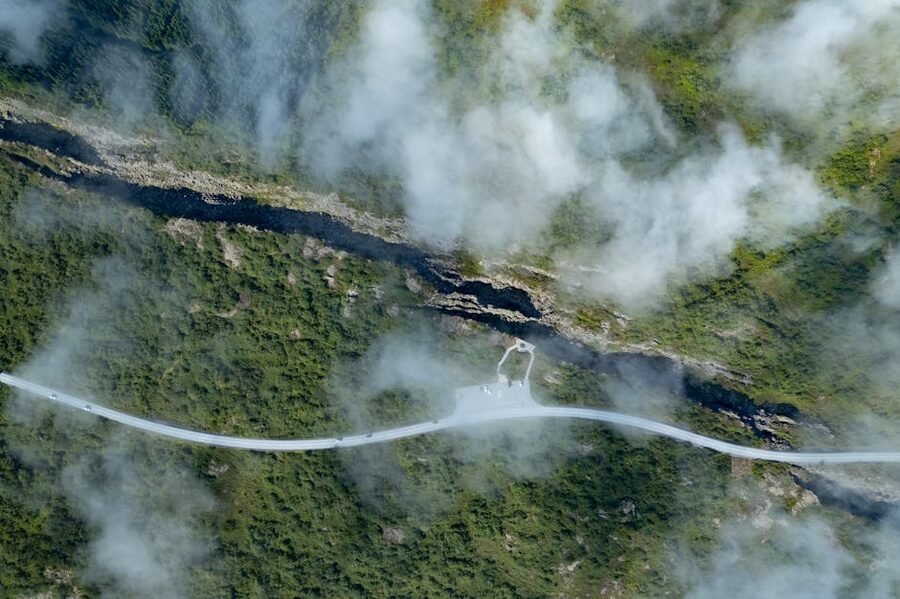
Easiest path: book direct on dive.is for the polished version, on adventures.is for Arctic Adventures, or on adventurevikings.is for the smaller-group option. Choose pickup or self-drive. Pay the deposit, sign the medical waiver online ahead of time, show up fifteen minutes early with a base layer and wool socks.
If you’re booking the trip in pieces through one of the platforms, the Silfra listings are easy to find on GetYourGuide and Viator; on Klook search “iceland snorkeling” and pick the Silfra-specific listing rather than the boat tours. Prices are usually within a few hundred ISK of booking direct.
For the drive, fuel up in Reykjavík; there are no petrol stations between you and Þingvellir if you take Route 36. The N1 at Mosfellsbær on the way out is the last one. Allow ninety minutes if conditions look variable, an hour if they’re clear.
Why Silfra is worth thirty minutes of your life
Iceland sells a lot of experiences and a lot of them are good. The Silfra snorkel is one of the few that genuinely belongs in the conversation about the best things to do in the country, alongside the Diamond Beach at sunrise, the Eldfell hike on Heimaey, and the first time you see the aurora actually move. It’s short, it’s expensive per minute, and the queue can be busy in summer. None of that matters once you’re in the water.
Thirty to forty minutes of floating between the continents in the cleanest, coldest, bluest water you’ll ever see. Then hot chocolate. Then the rest of the day in a country that has plenty more on offer. If you’ve got a single morning in Iceland and you can pick anything to do with it, this is one of the very few activities I’d put on the list without a caveat. Worth booking. Worth doing in February as much as in July. Worth the chunk of money it costs. You’ll remember it longer than you think.


.jpg)
.jpg)


.jpg)
.jpg)

.jpg)


.jpg)


